Question
A large nonconducting sheet M is given a uniform charge density. Two uncharged small metal rods A and B are placed near the sheet as shown in figure:
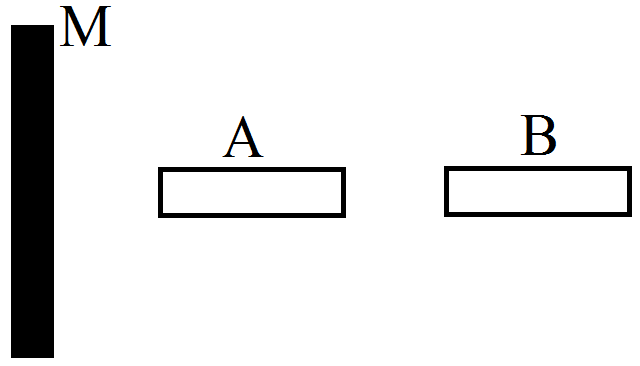
  1. M attracts A.
  2. M attracts B.
  3. A attracts B.
  4. B attracts A.

Answer

  1. B attracts A.

Explanation:

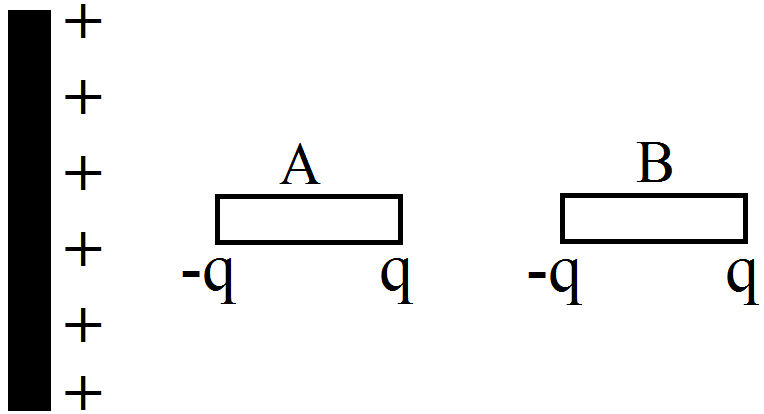
Charge distribution or M, A & B

So, we can say that M attracts A, M attracts B, A attracts B and 'B' attracts A.

Need a full question paper?

Generate a complete, print-ready paper with questions like this in minutes — across 16+ boards, with answer keys.

Start Generating Free

Similar questions

As shown in the figure a block of mass $10\,kg$ lying on a horizontal surface is pulled by a force $F$ acting at an angle $30^{\circ}$, with horizontal. For $\mu_{ s }=0.25$, the block will just start to move for the value of $F..........\,N$ : $\left[\right.$ Given $\left.g =10\,ms ^{-2}\right]$
A spherical drop of oil of radius $1\, cm$ is broken into $1000$ droplets of equal radii. If the surface tension of oil is $50$ dynes/cm, the work done is
A particle is moving along the circle $x^2 + y^2 = a^2$ in anti clock wise direction. The $x-y$ plane is a rough horizontal stationary surface. At the point $(a\, cos\theta , a\, sin\theta )$, the unit vector in the direction of friction on the particle is:
A uniform chain of length $L$ changes partly from a table which is kept in equilibrium by friction. The maximum length that can withstand without slipping is $l$, then coefficient of friction between the table and the chain is
A body projected vertically upwards with a certain speed from the top of a tower reaches the ground in $t_1$. If it is projected vertically downwards from the same point with the same speed, it reaches the ground in $t_2$. Time required to reach the ground, if it is dropped from the top of the tower, is:
A mass $m$ hangs with the help of a string wrapped around a pulley on a firctionless  bearing. The pulley has mass $m$ and radius $R$. Assuming pulley to be a perfect  uniform circular disc, the acceleration of the mass $m$, if the string does not slip on the  pulley, is:-
The velocity at the maximum height of a projectile is half of its initial velocity $u$. Its range on the horizontal plane is
The displacement x of a particle varies with time according to the relation $\text{x}=\frac{\text{a}}{\text{b}}(1-\text{e}^{-\text{bt}}).$ The:
At a certain depth "$d$" below surface of earth. value of acceleration due to gravity becomes four times that of its value at a height $3\,R$ above earth surface. Where $R$ is Radius of earth (Take $R =6400\,km$ ). The depth $d$ is equal to $............\,km$
A force $F$ is given by $F = at + b{t^2}$, where $t$ is time. What are the dimensions of $a$ and $b$