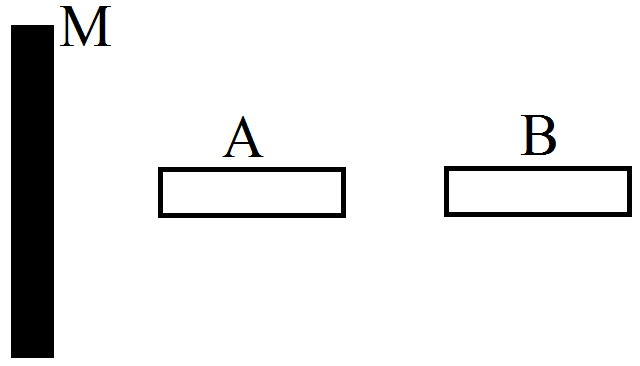
- M attracts A.
- M attracts B.
- A attracts B.
- B attracts A.
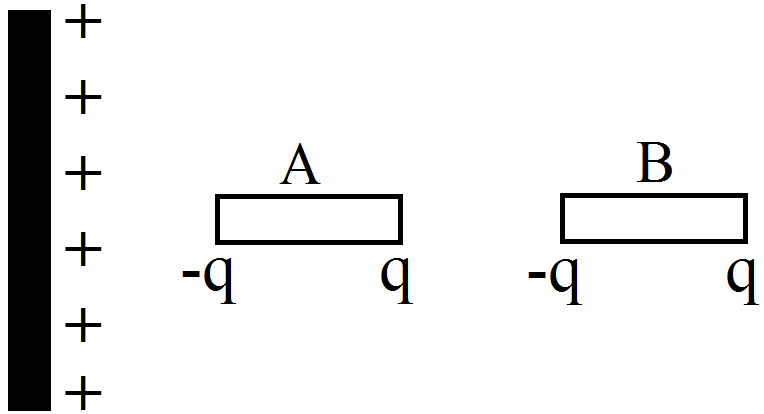

Explanation:

Charge distribution or M, A & B
So, we can say that M attracts A, M attracts B, A attracts B and 'B' attracts A.
Generate a complete, print-ready paper with questions like this in minutes — across 16+ boards, with answer keys.
For skywave propagation of a 10 MHz signal, what should be the minimum electron density in ionosphere
|
(a) ~ 1.2 |
(b) ~ |
(c) ~ |
(d) ~ |
Speed of light is maximum in
|
(a) Water |
(b) Air |
(c) Glass |
(d) Diamond |
A radioactive nucleus undergoes a-emission to form a stable element. What will be the recoil velocity of the daughter nucleus if V is the velocity of a-emission and A is the atomic mass of radioactive nucleus
|
(a) |
(b) |
(c) |
(d) |
A potentiometer consists of a wire of length 4 m and resistance 10Ω. It is connected to a cell of e.m.f. 2 V. The potential difference per unit length of the wire will be
|
(a) 0.5 V/m |
(b) 2 V/m |
(c) 5 V/m |
(d) 10 V/m |
A circular coil of radius 4 cm and of 20 turns carries a current of 3 amperes. It is placed in a magnetic field of intensity of 0.5
. The magnetic dipole moment of the coil is
|
(a) 0.15 |
(b) 0.3 |
(c) 0.45 |
(d) 0.6 |
Work done in moving a positive charge on an equipotential surface is
|
(a) Finite, positive but not zero |
(b) Finite, negative but not zero |
|
(c) Zero |
(d) Infinite |
A coil of inductance L is carrying a steady current i. What is the nature of its stored energy
|
(a) Magnetic |
(b) Electrical |
|
(c) Both magnetic and electrical |
(d) Heat |