MCQ
A large tank filled with water to a height ‘h’ is to be emptied through a small hole at the bottom. The ratio of time taken for the level of water to fall from $ h$  to $\frac{h}{2}$ and from $\frac{h}{2}$ to zero is
  • A
    $\sqrt 2 $
  • B
    $\frac{1}{{\sqrt 2 }}$
  • $\sqrt 2 - 1$
  • D
    $\frac{1}{{\sqrt 2 - 1}}$

Answer

Correct option: C.
$\sqrt 2 - 1$
c
(c)Time taken for the level to fall from H to $H'$ $t = \frac{A}{{{A_0}}}\sqrt {\frac{2}{g}} \,\,\left[ {\sqrt H - \sqrt {H'} } \right]$
According to problem- the time taken for the level to fall from h to $\frac{h}{2}$ ${t_1} = \frac{A}{{{A_0}}}\sqrt {\frac{2}{g}} \;\;\left[ {\sqrt h - \sqrt {\frac{h}{2}} } \right]$
and similarly time taken for the level to fall from $\frac{h}{2}$ to zero ${t_2} = \frac{A}{{{A_0}}}\sqrt {\frac{2}{g}} \;\left[ {\sqrt {\frac{h}{2}} - 0} \right]$ $\therefore \;\frac{{{t_1}}}{{{t_2}}} = \frac{{1 - \frac{1}{{\sqrt 2 }}}}{{\frac{1}{{\sqrt 2 }} - 0}} = \sqrt 2 - 1.$

Need a full question paper?

Generate a complete, print-ready paper with questions like this in minutes — across 16+ boards, with answer keys.

Start Generating Free

Similar questions

Latent heat of $1\,gm $ of steam is $536 \,cal/gm,$ then its value in $joule/kg$ is
A body performing simple harmonic motion is expressed by the displacement equation $\text{y}=4\sin2\text{t}$ The magnitude of maximum acceleration of the body is:
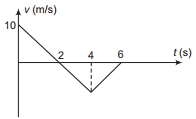
For the velocity-time graph shown in the figure, in a time interval from $t=0$ to $t=6\,s$, match the following columns.
Colum $I$ Colum $II$
$(A)$ Change in velocity $(p)$ $-5 / 3\,Sl$ unit
$(B)$ Average acceleration $(q)$ $-20\,SI$ unit
$(C)$ Total displacement $(r)$ $-10\,SI$ unit
$(D)$ Acceleration at $t=3\,s$ $(s)$ $-5\,SI$ unit

What is potential energy?
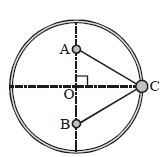
A bead of mass $m$ can slide on a frictionless fixed ring of very large radius $r$. With the help of two identical strings of force constant $k,$ it is connected to two diametrically opposite nails $A$ and $B$ each of which are at distance $0.5r$ from the centre $O$ of the ring. The relaxed length of each string is negligible as compared to the radius of the ring. The bead is given a small velocity. What can you predict for further motion of the bead before any of the strings strikes a nail?
An object flying in alr with velocity $(20 \hat{\mathrm{i}}+25 \hat{\mathrm{j}}-12 \hat{\mathrm{k}})$ suddenly breaks in two pleces whose masses are in the ratio $1: 5 .$ The smaller mass flies off with a velocity $(100 \hat{\mathrm{i}}+35 \hat{\mathrm{j}}+8 \hat{\mathrm{k}}) .$ The velocity of larger piece will be
One end of a horizontal thick copper wire of length $2 L$ and radius $2 R$ is welded to an end of another horizontal thin copper wire of length $L$ and radius $R$. When the arrangement is stretched by a applying forces at two ends, the ratio of the elongation in the thin wire to that in the thick wire is :
According to kinetic theory of gases the $\text{r.m.s}.$ velocity of the gas molecules is directly proportional to:
A mass $m$ is attached to a thin wire and whirled in a vertical circle. The wire is most likely to break when
A ring is suspended from a point $S$ on its rim as shown in the figure. When displaced from equilibrium, it oscillates with time period of $1\,second.$ The radius of the ring is ..... $m$ (take $g = \pi ^2$ )