MCQ
A laser is a coherent source because it contains
  • A
    Many wavelengths
  • B
    Uncoordinated wave of a particular wavelength
  • C
    Coordinated wave of many wavelengths
  • Coordinated waves of a particular wavelength

Answer

Correct option: D.
Coordinated waves of a particular wavelength
d
(d) LASER is the short form of Light Amplification by Stimulated Emission of Radiation.

Laser beam is intense, monochromatic (that is of the single wavelength) collimated and highly coherent.

Need a full question paper?

Generate a complete, print-ready paper with questions like this in minutes — across 16+ boards, with answer keys.
Start Generating Free

Similar questions

For the angle of minimum deviation of a prism to be equal to its refracting angle, the prism must be made of a material whose refractive index
A simple pendulum is suspended in a lift which is going up with an acceleration $5\ m/s^2$. An electric  field of magnitude $5 \ N/C$ and directed vertically upward is also present in the lift. The charge of the bob is $1\ mC$ and mass is $1\ mg$. Taking $g = \pi^2$ and length of the simple pendulum $1\ m$, the time period of the simple pendulum is ......$s$
The reflection surface of a plane mirror is vertical. $A$ particle is projected in a vertical plane which is also perpendicular to the mirror. The initial velocity of the particle is $10\, m/s$ and the angle of projection is $60^o$. The point of projection is at a distance $5\, m$ from the mirror. The particle moves towards the mirror. Just before the particle touches the mirror the velocity of approach of the particle and its image is ......$m/s$
Calculate the wavelength of light used in an interference experiment from the following data : Fringe width $=0.03\,cm$. Distance between the slits and eyepiece through which the interference pattern is observed is $1\,m$. Distance between the images of the virtual source when a convex lens of focal length $16\,cm$ is used at a distance of $80\,cm$ from the eyepiece is $0.8\,cm$.
The angular dispersion produced by a prism:
Which of the following particles will have minimum frequency of revolution when projected with the same velocity perpendicular to a magnetic field?
In which of the following systems will the radius of the first orbit $(n = 1)$ be minimum?
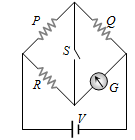
In the circuit shown P ≠ R, the reading of the galvanometer is same with switch S open or closed. Then

In a wire of circular cross-section with radius r, free electrons travel with a drift velocity V when a current I flows through the wire. What is the current in another wire of half the radius and of the same material when the drift velocity is 2V
Consider an electron $\left(\mathrm{m}=9.1 \times 10^{-31} \mathrm{~kg}\right)$ confined by electrical forces to move between two rigid walls separated by $1.0 \times 10^{-9}$ metre, which is about five atomic diameters. The quantised energy value for the lowest stationary state is