MCQ
A lens of focal power $0.5 D$ is
  • A
    A convex lens of focal length $0.5 \mathrm{~m}$
  • B
    A concave lens of focal length $0.5 \mathrm{~m}$
  • A convex lens of focal length $2 \mathrm{~m}$
  • D
    A concave lens of focal length $2 \mathrm{~m}$

Answer

Correct option: C.
A convex lens of focal length $2 \mathrm{~m}$
$P=\frac{1}{f} \Rightarrow f=\frac{1}{0.5}=2 m$

Need a full question paper?

Generate a complete, print-ready paper with questions like this in minutes — across 16+ boards, with answer keys.
Start Generating Free

Similar questions

Length cannot be measured by
In the formation of primary rainbow, the sunlight rays emerge at minimum deviation from rain-drop after
In a magnetic field of $0.05^T$, area of a coil changes from $101 \mathrm{~cm}^2$ to $100 \mathrm{~cm}^2$ without changing the resistance which is $2 \Omega$. The amount of charge that flow during this period is
Two masses $m_A$ and $m_B$ moving with velocities $v_A$ and $v_B$ in opposite directions collide elastically. After that the masses $m_A$ and $m_B$ move with velocity $v_B$ and $v_A$ respectively. The ratio $\left(m_A / m_B\right)$ is
In extrinsic $P$ and $N$-type, semiconductor materials, the ratio of the impurity atoms to the pure semiconductor atoms is about
Mercury boils at $367^{\circ} \mathrm{C}$. However, mercury thermometers are made such that they can measure temperature up to $500^{\circ} \mathrm{C}$. This is done by
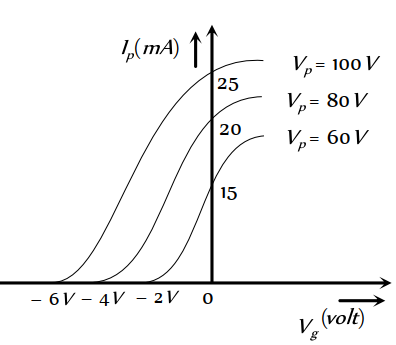
The variation of anode current in a triode corresponding to a change in grid potential at three different values of the plate potential is shown in the diagram. The mutual conductance of the triode isImage
Two particles of masses $m_1$ and $m_2$ in projectile motion have velocities $\vec{v}_1$ and $\vec{v}_2$ respectively at time $t=0$. They collide at time $t_0$. Their velocities become $\vec{v}_1{ }^{\prime}$ and $\vec{v}_2{ }^{\prime}$ at time $2 t_0$ while still moving in air. The value of $\left|\left(m_1 \overrightarrow{v_1^{\prime}}+m_2 \overrightarrow{v_2^{\prime}}\right)-\left(m_1 \overrightarrow{v_1}+m_2 \overrightarrow{v_2}\right)\right|$ is
If a current of $3.0$ amperes flowing in the primary coil is reduced to zero in $0.001$ second, then the induced e.m.f. in the secondary coil is $15000$ volts. The mutual inductance between the two coils is
In hydrogen atom, the electron is making $6.6 \times {10^{15}}\,rev/\sec $ around the nucleus in an orbit of radius $0.528\, \mathop A\limits^o $. The magnetic moment $(A - {m^2})$ will be