MCQ
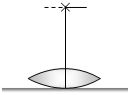
A lens when placed on a plane mirror then object needle and its image coincide at $15 \,cm$. The focal length of the lens is......$cm$
  • $15$
  • B
    $30$
  • C
    $20$
  • D
    $\infty$ 

Answer

Correct option: A.
$15$
a
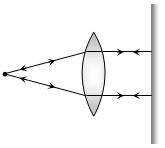
(a) When the object is placed at focus the rays are parallel. The mirror placed normal sends them back. Hence image is formed at the object itself as illustrated in figure.

Need a full question paper?

Generate a complete, print-ready paper with questions like this in minutes — across 16+ boards, with answer keys.

Start Generating Free

Similar questions

The energy required to break one bond in $DNA$ is $10^{-20}\, J.$ This value in $eV$ is nearly
$100\  g$ of water is heated from $30^o\ C$ to $50^o\ C$ Ignoring the slight expansion of the water, the change in its internal energy is ...... $kJ$ (specific heat of water is $4184\  J/kg/K$)
A vertical hanging bar of length $l$ and mass $m$ per unit length carries a load of mass $M$ at lower end, its upper end is clamped to a rigid support. The tensile stress a distance $x$ from support is $(A \rightarrow$ area of cross-section of bar)
The binding energy per nucleon for $C^{12}$ is $7.68\, MeV$ and that for $C^{13}$ is $7.5\, MeV.$ The energy required to remove a neutron from $C^{13}$ is ......... $MeV$
A ray of light is incident on a $60^o$ prism at the minimum deviation position. The angle of refraction at the first face (i.e., incident face) of the prism is.......$^o$
The semiconductors are generally
Objective lens of a telescope has focal length $100\, cm$. When the final image is formed  at least distance of distinct vision, the distance between the lenses is $105\, cm.$  Calculate the focal length of eye piece.......$cm$
Given below are two statements :
Statement - I : The hot water flows faster than cold water.
Statement-II : Soap water has higher surface tension as compared to fresh water.
In the light above statements, choose the correct answer from the options given below
The gravitational force between two point masses ${m_1}$ and ${m_2}$ at separation $r$ is given by $F = k\frac{{{m_1}{m_2}}}{{{r^2}}}$ The constant $k$
Two capacitors $C_1$ and $C_2$ are charged to $120\ V$ and $200\ V$ respectively. It is found that connecting them together the potential on each one can be made zero. Then