A lift is moving downwards with an acceleration equal to acceleration due to gravity. $A$ body of mass $M$ kept on the floor of the lift is pulled horizontally. If the coefficient of friction is $\mu $, then the frictional resistance offered by the body is
Easy
Download our app for free and get started
(d) $R = m(g - a)$ for downward motion of lift
If $a = g$ then $R = 0$ $\therefore \;\;F = \mu \;R = 0$

Download our appand get started for free
Experience the future of education. Simply download our apps or reach out to us for more information. Let's shape the future of learning together!No signup needed.*
Similar Questions
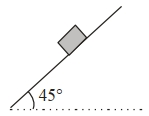
- 1Consider a block kept on an inclined plane (inclined at $45^{\circ}$ ) as shown in the figure. If the force required to just push it up the incline is $2$ times the force required to just prevent it from sliding down, the coefficient of friction between the block and inclined plane $(\mu)$ is equal toView Solution
- 2A given object takes $n$ times the time to slide down $45^{\circ}$ rough inclined plane as it takes the time to slide down an identical perfectly smooth $45^{\circ}$ inclined plane. The coefficient of kinetic friction between the object and the surface of inclined plane is :View Solution
- 3A roller coaster is designed such that riders experience "weightlessness" as they go round the top of a hill whose radius of curvature is $20\, m.$ The speed of the car at the top of the hill is betweenView Solution
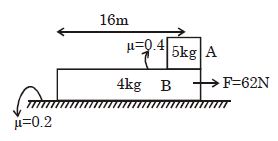
- 4Initially the whole system is at rest and now a force of $62\ N$ is applied on the block $B$ as shown in the figure. Find the time taken by $'A'$ to fall from the block $'B'$ ........... $\sec$View Solution
- 5A block of mass $m$ slides along a floor while a force of magnitude $F$ is applied to it at an angle $\theta$ as shown in figure. The coefficient of kinetic friction is $\mu_{ K }$. Then, the block's acceleration $'a'$ is given by: ($g$ is acceleration due to gravity)View Solution

- 6A person with his hands in his pockets is skating on ice at the velocity of $10 \,m/s$ and describes a circle of radius $50\, m$. What is his inclination with verticalView Solution
- 7A body of mass $2\,kg$ slides down with an acceleration of $3\,m/s^2$ on a rough inclined plane having a slope of $30^o$ . The external force required to take the same body up the plane with the same acceleration will be ........ $N$ $(g\, = 10\, m/s^2)$View Solution
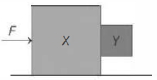
- 8Consider the system shown below. A horizontal force $F$ is applied to a block $X$ of mass $8 \,kg$, such that the block $Y$ of mass $2 \,kg$ adjacent to it does not slip downwards under gravity. There is no friction between the horizontal plane and the base of the block $X$. The coefficient of friction between the surfaces of blocks $X$ and $Y$ is $0.5$. The minimum value of $F$ is ............ $N$ (take, acceleration due to gravity to be $10 \,ms ^{-2}$ )View Solution
- 9$Assertion$ : On a rainy day it is difficult to drive a car or bus at high speed.View Solution
$Reason$ : The value of coefficient of friction is lowered due to wetting of the surface - 10A mass of $2 \,kg$ is whirled in a horizontal circle by means of a string at an initial speed of $5$ revolutions per minute. Keeping the radius constant the tension in the string is doubled. The new speed is nearly ....... $rpm$View Solution