Question
A light emitting diode $(LED)$ is fabricated using GaAs semiconducting material whose band gap is $1.42 \mathrm{eV}$. The wavelength of light emitted from the $LED$ is:

Answer

$\lambda=\frac{1240}{1.42}=875 \mathrm{~nm}$ $(Approx)$

Need a full question paper?

Generate a complete, print-ready paper with questions like this in minutes — across 16+ boards, with answer keys.
Start Generating Free

Similar questions

Two thin long parallel wires, separated by a distance $d$ carry a current of $I$ $amp$ in  the same direction. They will
A Carnot engine with efficiency $50\,\%$ takes heat from a source at $600\,K$. In order to increase the efficiency to $70\,\%$, keeping the temperature of sink same, the new temperature of the source will be $.........\,K$
Assertion : In photoemissive cell inert gas is used.
Reason : Inert gas in the photoemissive cell gives greater current.
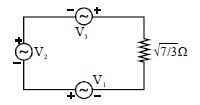
Three alternating voltage sources $V_1$ = $3 sin \omega t $ volt , $V_2= 5  sin(\omega t + \phi _1)$ volt and $V_3 = 5  sin(\omega t -\phi_2 )$ volt connected across a resistance $R= \sqrt {\frac{7}{3}} \Omega $ as shown in the figure (where $ \phi_1$  and $ \phi_2$   corresponds to $30^o $ and $127^o $ respectively). Find the peak current (in Amp) through the resistor
Work done on or by a gas, in general depends upon the
When an electron does transition from $n=4$ to $n=2$, then emitted line spectrum will be
The distance of an object from a spherical mirror is equal to the focal length of the mirror. Then the image:
Two vessels of the same volume contain the same gas at same temperature. If the pressure in the vessels be in the ratio of $1 : 2$, then
You are on a frictionless horizontal plane. How can you get off if no horizontal force is exerted by pushing against the surface
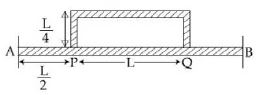
Temperature difference of $120\,^oC$ is maintained between two ends of a uniform rod $AB$ of length $2L$. Another bent rod $PQ$, of same cross-section as $AB$ and length $\frac{{3L}}{2}$,  is connected across $AB$ (See figure). In steady state, temperature difference between $P$ and $Q$ will be close to .......... $^oC$