Question

A light ray is incident upon a prism in minimum deviation position and suffers a deviation of 34°.  If the shaded half of the prism is knocked off, the ray will

(a) Suffer a deviation of 34°

(b) Suffer a deviation of 68°

(c) Suffer a deviation of 17°

(d) Not come out of the prism

Answer

(c) Suffer a deviation of 17°

Need a full question paper?

Generate a complete, print-ready paper with questions like this in minutes — across 16+ boards, with answer keys.

Start Generating Free

Similar questions

Which of the following phenomena suggests the presence of electron energy levels in atoms

(a) Radio active decay

(b) Isotopes

(c) Spectral lines

(d) a -particles scattering

Two protons are kept at a separation of 10nm. Let Fn and Fe be the nuclear force and the electromagnetic force between them:
The self inductance L of a solenoid of length l and area of crosssection A, with a fixed number of turns N increases as:

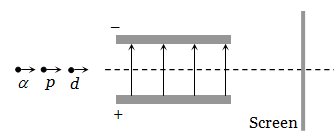
A proton, a deutron and an a-particle having the same momentum, enters a region of uniform electric field between the parallel plates of a capacitor. The electric field is perpendicular to the initial path of the particles. Then the ratio of deflections suffered by them is

(a) 1 : 2 : 8

(b) 1 : 2 : 4

(c) 1 : 1 : 2

(d) None of these

Self induction of a solenoid is

(a) Directly proportional to current flowing through the coil

(b) Directly proportional to its length

(c) Directly proportional to area of cross-section

(d) Inversely proportional to area of cross-section

For a nuclear fusion process, suitable nuclei are:
Two identical cycle wheels (geometrically) have different number of spokes connected from center to rim. One is having 20 spokes and the other having only 10 (the rim and the spokes are resistanceless). One resistance of value R is connected between center and rim. The current in R will be.

A triangular loop of side l carries a current I. It is placed in a magnetic field B such that the plane of the loop is in the direction of B. The torque on the loop is

(a) Zero

(b) IBl

(c)  

(d)  

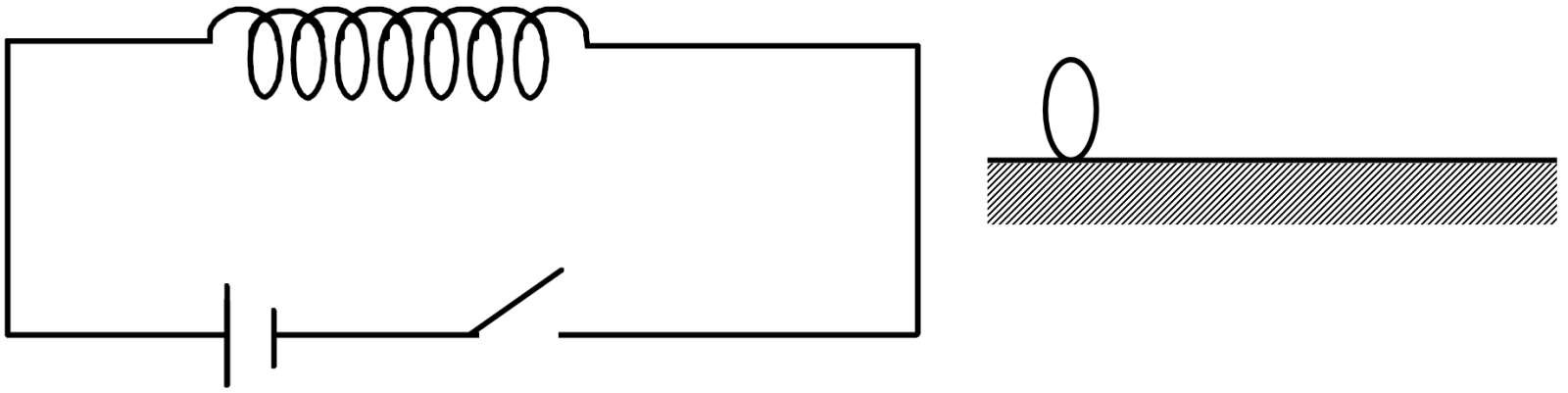
Figure shows a horizontal solenoid connected to a battery and a switch. A copper ring is placed on a frictionless track, the axis of the ring being along the axis of the solenoid. As the switch is closed, the ring will:
  1. Remain stationary.
  2. Move towards the solenoid.
  3. Move away from the solenoid.
  4. Move towards the solenoid or away from it depending on which terminal (positive or negative) of the battery is connected to the left end of the solenoid.

Meteors are

(a) Small stars

(b) Burnt pieces of comets that fall on earth

(c) Comets without tails

(d) None of these