MCQ
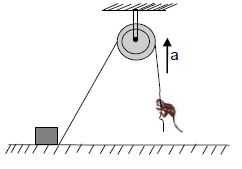
A light string fixed at one end to a clamp on ground passes over a fixed pulley and hangs at the other side. It makes an angle of $30^o$ with the ground. A monkey of mass $5\ kg$ climbs up the rope. The clamp can tolerate a vertical force of $40\ N$ only. The maximum acceleration in upward direction with which the monkey can climb safely is ............ $m/s^2$ (neglect friction and take $g = 10\ m / s^2$ )
  • A
    $2$
  • B
    $4$
  • $6$
  • D
    $8$

Answer

Correct option: C.
$6$
c
Let $T$ be the tension in the string.

The upward force exerted on the clamp $=T \sin 30^{\circ}=\frac{T}{2}$

$\text { Given: } \frac{T}{2}=40 N \text { or } T=80 N$        $...(i)$

If $a$ is the acceleration of monkey in upward direction,

$a=\frac{T-m g}{m}=\frac{80-5 \times 10}{5}=6 m / s^{2}$

Need a full question paper?

Generate a complete, print-ready paper with questions like this in minutes — across 16+ boards, with answer keys.

Start Generating Free

Similar questions

A ball is dropped from a height of $49\,m$. The wind is blowing horizontally. Due to wind a constant horizontal acceleration is provided to the ball. Choose the correct statement (s). (Take $g=9.8\,m / s ^2$ )
Speed-time graph of two cars $A$ and $B$ approaching towards each other is shown in figure. Initial distance between them is $60\,m$. The two cars will cross each other after time $..........\,s$
A particle projected from origin moves in $x-y$ plane with a velocity $\vec{v}=3 \hat{i}+6 x \hat{j}$, where $\hat{i}$ and $\hat{j}$ are the unit vectors along $x$ and $y$ axis. Find the equation of path followed by the particle
The $v -t$ graph of a rectilinear motion is shown in adjoining figure. The distance from  starting point after $8$ seconds is ..........$metre$
A body of $5\, kg$ weight kept on a rough inclined plane of angle $30^o$ starts sliding with a constant velocity. Then the coefficient of friction is 
Two discs of moment of inertia $I_1=4 \mathrm{~kg} \mathrm{~m}^2$ and $\mathrm{I}_2=2 \mathrm{~kg} \mathrm{~m}^2$ about their central axes & normal to their planes, rotating with angular speeds $10 \mathrm\ {rad} / \mathrm{s}$ & $4  \mathrm\ {rad} / \mathrm{s}$ respectively are brought into contact face to face with their axe of rotation coincident. The loss in kinetic energy of the system in the process is____ $\mathrm{J}$.
A particle has a velocity u towards east at t = 0. Its acceleration is towards west and is constant. Let xA and xB be the magnitude of displacements in the first 10 seconds and the next 10 seconds:
  1. xA < xB
  2. xA = xB
  3. xA > xB
  4. The information is insufficient to decide the relation of xA with xB.
There is a relationship between the pressure P of an ideal gas and the average kinetic energy E of the gas in unit volume.
A cubic vessel (with face horizontal + vertical) contains an ideal gas at NTP. The vessel is being carried by a rocket which is moving at a speed of 500ms-1 in vertical direction. The pressure of the gas inside the vessel as observed by us on the ground:
  1. Remains the same because 500ms-1 is very much smaller than vrms of the gas.
  2. Remains the same because motion of the vessel as a whole does not affect the relative motion of the gas molecules and the walls.
  3. Will increase by a factor equal to (v2rms + (500)2)/ v2rms where vrms was the original mean square velocity of the gas.
  4. Will be different on the top wall and bottom wall of the vessel.
The relation between the gas pressure $P$ and average kinetic energy per unit volume $E$ is