MCQ
A light unstretchable string passing over a smooth light pulley connects two blocks of masses $m_1$ and $m_2$. If the acceleration of the system is $\frac{g}{8}$, then the ratio of the masses $\frac{\mathrm{m}_2}{\mathrm{~m}_1}$ is:
  • $9: 7$
  • B
    $4: 3$
  • C
    $5: 3$
  • D
    $8: 1$

Answer

Correct option: A.
$9: 7$
a
$a_{5 y s}=\left(\frac{m_2-m_1}{m_1+m_2}\right) g=\frac{g}{8}$

$\Rightarrow \frac{m_2}{m_1}=\frac{9}{7}$

Need a full question paper?

Generate a complete, print-ready paper with questions like this in minutes — across 16+ boards, with answer keys.

Start Generating Free

Similar questions

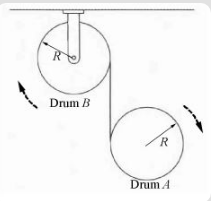
Drum A undergoes:
The horizontal acceleration that should be given to a smooth inclined plane of angle $sin^{-1}\, (1/l)$ to keep an object stationary on the plane relative to the inclined plane is
What is meant by mean free path?
A particle of mass m is executing oscillations about the origin on the $X-$axis. Its potential energy is $U(x) = k{[x]^3}$, where $k$ is a positive constant. If the amplitude of oscillation is $a$, then its time period $T$ is
Two identical satellites are at the heights $R$ and $7R$ from the Earth's surface. Then which of the following statement is incorrect. ($R =$ radius of the Earth)
$Assertion :$ A body that is good radiator is also a good absorber of radiation at a given wavelength.
$Reason :$ According to Kirchhoff’s law the absorptivity of a body is equal to its emissivity at a given wavelength.
Two point masses of $0.3\, kg$ and $0.7\, kg$ are fixed at the ends of a rod of length $1.4\, m$ and of negligible mass. The rod is set rotating about an axis perpendicular to its length with a uniform angular speed. The point on the rod through which the axis should pass in order that the work required for rotation of the rod is minimum is located at a distance of
Two identical adiabatic vessels are filled with oxygen at pressure $P_1$ and $P_2 (P_1 > P_2).$ The vessels are interconnected with each other by a nonconducting pipe. If $U_{01}$ and $U_{02}$ denote initial internal energy of oxygen in first and second vessel respectively and $U_{f_1}$ and  $U_{f_2}$ denote final internal energy values, than :
For three vectors $\vec{A}=(-x \hat{i}-6 \hat{j}-2 \hat{k})$, $\vec{B}=(-\hat{i}+4 \hat{j}+3 \hat{k})$ and $\vec{C}=(-8 \hat{i}-\hat{j}+3 \hat{k})$, if $\overrightarrow{\mathrm{A}} \cdot(\overrightarrow{\mathrm{B}} \times \overrightarrow{\mathrm{C}})=0$, them value of $\mathrm{x}$ is. . . . . .. 
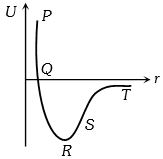
The points of maximum and minimum attraction in the curve between potential energy $(U)$ and distance $(r)$ of a diatomic molecules are respectively