MCQ
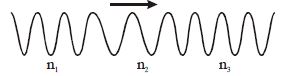
A light wave travels through three transparent materials of equal thickness. Rank in order, from the highest to lowest, the indices of refraction $n_1, n_2$ and $n_3$.
  • $n_3 > n_1 > n_2$
  • B
    $n_1 < n_3 < n_2$
  • C
    $n_3 < n_1 > n_2$
  • D
    $n_2 > n_3 > n_1$

Answer

Correct option: A.
$n_3 > n_1 > n_2$
a
${\lambda ^i} = \frac{\lambda }{n}$

${\lambda _2} > {\lambda _1} < {\lambda _3}$

${n_2} < {n_1} < {n_3}$

Need a full question paper?

Generate a complete, print-ready paper with questions like this in minutes — across 16+ boards, with answer keys.

Start Generating Free

Similar questions

A beaker full of hot water is kept in a room and it cools from $80^\circ C$ to $75^\circ C$ in $t_1$ minutes, from $75^\circ C$ to $70^\circ C$ in $t_2$ minutes and from $70^\circ C$ to $65^\circ C$ in $t_3$ minutes. Then:
This question has Statement $-1$ and Statement $-2$. Of the four choices given after the statements, choose the one that best describes the two statements.

If two springs $S_1$ and $S_2$ of force constants $k_1$ and $k_2$, respectively, are stretched by the same force, it is found that more work is done on spring $S_1$ than on spring $S_2$.

Statement $-1$: If stretched by the same amount, work done on $S_1$, will be more than that on $S_2$

Statement $-2$ : $k_1 < k_2$.

convert $1\; newton$ ($SI$ unit of force) into $dyne$ ($CGS$ unit of force) 
A block of mass $m$ slides down a smooth vertical circular track. During the motion, the block is in:
A spaceship of speed $v_0$ travelling along $+ y$ axis suddenly shots out one fourth of its part with speed $2v_0$ along $+ x$ -axis. $xy$ axes are fixed with respect to ground. The velocity of the remaining part is
An aircraft executes a horizontal loop with a speed of $150\, m/s$ with its wings banked at an angle of $12^o$. The radius of the loop is ..........  $km$ $(g = 10\, m/s^2 \; and\; \tan 12^o = 0.2125)$
The radius of gyration of a uniform rod of length $l,$ about an axis passing through a point $\frac{l}{4}$ away from the centre of the rod, and perpendicular to it, is
The periodic time of a simple pendulum of length $1\, m $ and amplitude $2 \,cm $ is $5\, seconds$. If the amplitude is made $4\, cm$, its periodic time in seconds will be
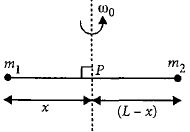
Point masses $m_1$ and $m_2$ are placed at the opposite ends of a rigid rod of length $L$, and negligible  mass. The rod is to be set rotating about an axis perpendicular to it. The position of point $P$ on this rod through which the axis should pass so that the work required to set the rod rotating with angular velocity $\omega_0$ is minimum, is given by
At a given temperature the force between molecules of a gas as a function of intermolecular distance is: