Question
A line is parallel to one side of triangle which intersects remaining two sides in two distinct points then that line divides sides in same proportion.
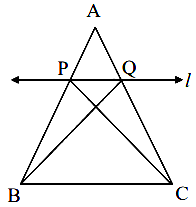
Given: In $\triangle A B C$ line I || side $B C$ and line I intersect side $A B$ in $P$ and side $A C$ in $Q$.
To prove: $\frac{ AP }{ PB }=\frac{ AQ }{ QC }$
Construction: Draw $CP$ and $BQ$
Proof: $\triangle APQ$ and $\triangle PQB$ have equal height.
$\left.\frac{ A (\Delta APQ )}{ A (\Delta PQB )}=\frac{[}{ PB } \quad \ldots . . \text { (i) [areas in proportion of base }\right]$
$\frac{ A (\Delta APQ )}{ A (\Delta PQC )}=\frac{[}{ QC } \ldots . . . \text { (ii) [areas in proportion of base] }$
$\triangle P Q C$ and $\triangle P Q B$ have [____ ] is common base.
Seg PQ \| Seg BC, hence height of $\triangle A P Q$ and $\triangle P Q B$.
$A (\triangle PQC )= A (\Delta \ldots, \ldots \text {.....(iii) }$
$\frac{ A (\Delta APQ )}{ A (\Delta PQB )}=\frac{ A (\Delta \ldots)}{ A (\Delta \ldots \ldots[( i ) \text {, (ii), and (iii)] }}$
$\frac{ AP }{ PB }=\frac{ AQ }{ QC } \quad \ldots . . .[( i ) \text { and (iii)] }$
Given: In $\triangle A B C$ line I || side $B C$ and line I intersect side $A B$ in $P$ and side $A C$ in $Q$.
To prove: $\frac{ AP }{ PB }=\frac{ AQ }{ QC }$
Construction: Draw $CP$ and $BQ$
Proof: $\triangle APQ$ and $\triangle PQB$ have equal height.
$\left.\frac{ A (\Delta APQ )}{ A (\Delta PQB )}=\frac{[}{ PB } \quad \ldots . . \text { (i) [areas in proportion of base }\right]$
$\frac{ A (\Delta APQ )}{ A (\Delta PQC )}=\frac{[}{ QC } \ldots . . . \text { (ii) [areas in proportion of base] }$
$\triangle P Q C$ and $\triangle P Q B$ have [____ ] is common base.
Seg PQ \| Seg BC, hence height of $\triangle A P Q$ and $\triangle P Q B$.
$A (\triangle PQC )= A (\Delta \ldots, \ldots \text {.....(iii) }$
$\frac{ A (\Delta APQ )}{ A (\Delta PQB )}=\frac{ A (\Delta \ldots)}{ A (\Delta \ldots \ldots[( i ) \text {, (ii), and (iii)] }}$
$\frac{ AP }{ PB }=\frac{ AQ }{ QC } \quad \ldots . . .[( i ) \text { and (iii)] }$