Question
A linear programming problem (LPP) along eith the graph of its constraints is shown below.The correspondig objective function is :Z = 18x + 10y which has to be minimized. The smallest value of the objective function Z is 134 and is obtained at the corner point (3,8).
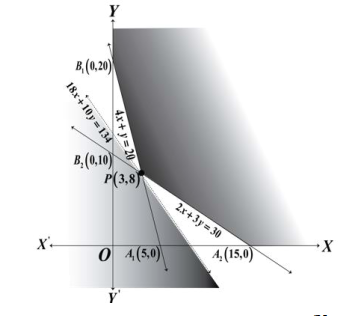
Image
The optimal solution of the above linear programming problem_______________.

Answer

Since the inequality Z = 18x + 10y < 134 has no point in common with the feasible region hence the minimum value of the objective function Z = 18x + 10y is 134 at P(3,8).

Need a full question paper?

Generate a complete, print-ready paper with questions like this in minutes — across 16+ boards, with answer keys.

Start Generating Free

Similar questions

The function f(x) = x − [x], where [⋅] denotes the greatest integer function is:
  1. Continuous everywhere.
  2. Continuous at integer points only.
  3. Continuous at non-integer points only.
  4. Differentiable everywhere.
Maximize $Z = 10 x_1 + 25 x_2,$ subject to $0\leq\text{x}_{1}\leq3,0\leq\text{x}_{2}\leq3,\text{x}_{1}+\text{x}_{2}\leq5.$
Evaluate: $\int \frac{10 x^9+10^x \log _e 10}{10^x+x^{10}} d x$
If 2x + 5y - 6z + 3 = 0 be the equation of the plane, then the equation of any plane parallel to the given plane is:
Refer to Question 18 (Maximum value of Z+ Minimum value of Z) is equal to:
  1. 13
  2. 1
  3. -13
  4. -17
$\int\frac{1}{7+5\cos\text{x}}\text{ dx}=$
  1. $\frac{1}{\sqrt{6}}\tan^{-1}\Big(\frac{1}{\sqrt{6}}\tan\frac{\text{x}}{2}\Big)+\text{C}$
  2. $\frac{1}{\sqrt{3}}\tan^{-1}\Big(\frac{1}{\sqrt{3}}\tan\frac{\text{x}}{2}\Big)+\text{C}$
  3. $\frac{1}{4}\tan^{-1}\Big(\tan\frac{\text{x}}{2}\Big)+\text{C}$
  4. $\frac{1}{7}\tan^{-1}\Big(\tan\frac{\text{x}}{2}\Big)+\text{C}$
Mark the correct alternative in the following question:The probability of guessing correctly at least 8 out of 10 answers of a true false type examination is:
  1. $\frac{7}{64}$
  2. $\frac{7}{128}$
  3. $\frac{45}{1024}$
  4. $\frac{7}{41}$
Find the value of $p$ for which the points $(−5, 1), (1, p)$ and $(4, −2)$ are collinear.
If $\text{y}=\log\sqrt{\tan\text{x}},$ then the value of $\frac{\text{dy}}{\text{dx}}$ at $\text{x}=\frac{\pi}{4}$ is givne by:
  1. $\infty$
  2. $1$
  3. $0$
  4. $\frac{1}{2}$
Let $X_1$ and $X_2$ are optimal solutions of a $\text{LPP},$ then: