MCQ
A liquid is flowing in a horizontal uniform capillary tube under a constant pressure difference $P$. The value of pressure for which the rate of flow of the liquid is doubled when the radius and length both are doubled is
  • A
    $P$ 
  • B
    $\frac{{3P}}{4}$
  • C
    $\frac{P}{2}$
  • $\frac{P}{4}$

Answer

Correct option: D.
$\frac{P}{4}$
d
(d)From $V = \frac{{P\pi {r^4}}}{{8\eta l}}$ ==> $P = \frac{{V8\eta l}}{{\pi {r^4}}}$
==>$\frac{{{P_2}}}{{{P_1}}} = \frac{{{V_2}}}{{{V_1}}} \times \frac{{{l_2}}}{{{l_1}}} \times {\left( {\frac{{{r_1}}}{{{r_2}}}} \right)^4}$$ = 2 \times 2 \times {\left( {\frac{1}{2}} \right)^4} = \frac{1}{4}$
==> ${P_2} = \frac{{{P_1}}}{4} = \frac{P}{4}$.

Need a full question paper?

Generate a complete, print-ready paper with questions like this in minutes — across 16+ boards, with answer keys.

Start Generating Free

Similar questions

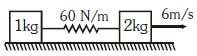
Two blocks of mass $1\  kg$ and $2\  kg$ are connected with each other with a spring of spring constant $60\  N/m$. If the velocity given to the block of mass $ 2\  kg$ at the natural length is $6\  m/s$. Find the maximum veloicty of $1\  kg$ block in subsequent motion (in $m/s$).
Two balls $A$ and $B$ are thrown with same velocity $u$ from the top of a tower. Ball $A$ is thrown vertically upwards and the ball $B$ is thrown vertically downwards.Choose the correct statement
Two bodies are thrown simultaneously from a tower with same initial velocity ${v_0}:$ one vertically upwards, the other vertically downwards. The distance between the two bodies after time $t$ is
If $x = at + b{t^2}$, where $x$ is the distance travelled by the body in kilometres while $t$ is the time in seconds, then the units of $b$ are
The internal energy of an ideal gas decreases by the same amount as the work done by the system:
  1. The process must be adiabatic.
  2. The process must be isothermal.
  3. The process must be isobaric.
  4. The temperature must decrease.
A particle is moving with speed $6\,m/s$ along the direction of  $\vec A = 2\hat i + 2\hat j - \hat k,$ then its velocity is
A particle performs simple harmonic motion with amplitude $A$. Its speed is trebled at the instant that it is at a distance $\frac{{2A}}{3}$ from equilibrium position. The new amplitude of the motion is
If $\varepsilon_0$ is the permittivity of free space and $E$ is the electric field, then $\varepsilon_0 E^2$ has the dimensions
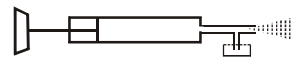
A spray gun is shown in the figure where a piston pushes air out of a nozzle. A thin tube of uniform cross section is connected to the nozzle. The other end of the tube is in a small liquid container. As the piston pushes air through the nozzle, the liquid from the container rises into the nozzle and is sprayed out. For the spray gun shown, the radii of the piston and the nozzle are $20 \ mm$ and $1 \ mm$ respectively. The upper end of the container is open to the atmosphere. $Image$

$1.$ If the piston is pushed at a speed of $5 \ mms ^{-1}$, the air comes out of the nozzle with a speed of

$(A)$ $0.1 \ ms ^{-1}$ $(B)$ $1 \ ms ^{-1}$ $(C)$ $2 \ ms ^{-1}$ $(D)$ $8 \ ms ^{-1}$

$2.$ If the density of air is $\rho_{ a }$ and that of the liquid $\rho_{\ell}$, then for a given piston speed the rate (volume per unit time) at which the liquid is sprayed will be proportional to

$(A)$ $\sqrt{\frac{\rho_{ a }}{\rho_{\ell}}}$ $(B)$ $\sqrt{\rho_a \rho_{\ell}}$ $(C)$ $\sqrt{\frac{\rho_{\ell}}{\rho_{ a }}}$ $(D)$ $\rho_{\ell}$

Give the answer question $1$ and $2.$
 A container has 3 gases whose mass ratio is 1:3:5. What is the ratio of mean square speed of the molecules of two gases? Their atomic masses are 20u, 30u & 40u corresponding to the order in which the ratios are given.