MCQ
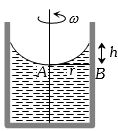
A liquid is kept in a cylindrical vessel which is being rotated about a vertical axis through the centre of the circular base. If the radius of the vessel is $ r $ and angular velocity of rotation is $\omega $, then the difference in the heights of the liquid at the centre of the vessel and the edge is
  • A
    $\frac{{r\omega }}{{2g}}$
  • $\frac{{{r^2}{\omega ^2}}}{{2g}}$
  • C
    $\sqrt {2gr\omega } $
  • D
    $\frac{{{\omega ^2}}}{{2g{r^2}}}$

Answer

Correct option: B.
$\frac{{{r^2}{\omega ^2}}}{{2g}}$
b
(b)From Bernoulli's theorem,
${P_A} + \frac{1}{2}dv_A^2 + dg{h_A} = {P_B} + \frac{1}{2}dv_B^2 + dg{h_B}$
Here, ${h_A} = {h_B}$
$\therefore \;{P_A} + \frac{1}{2}dv_A^2 = {P_B} + \frac{1}{2}dv_B^2$
==> ${P_A} - {P_B} = \frac{1}{2}d[v_B^2 - v_A^2]$
Now, ${v_A} = 0,\;{v_B} = r\omega $ and ${P_A} - {P_B} = hdg$
$\therefore \;\;hdg = \frac{1}{2}d{r^2}{\omega ^2}$ or $h = \frac{{{r^2}{\omega ^2}}}{{2g}}$

Need a full question paper?

Generate a complete, print-ready paper with questions like this in minutes — across 16+ boards, with answer keys.

Start Generating Free

Similar questions

When two small bubbles join to form a bigger one, energy is
A bullet of mass $10\, g$ and speed $500\, m/s$ is fired into a door and gets embedded exactly at the centre of the door. The door is $1.0\, m$ wide and weighs $12\, kg$. It is hinged at one end and rotates about a vertical axis practically without friction . The angular speed of the door just after the bullet embeds into it will be
The decay constant of a radioactive element is $0.01$ per second. Its half life period is .......$sec$
An electric dipole of moment $\overrightarrow{\mathrm{p}}=(-\hat{\mathrm{i}}-3 \hat{\mathrm{j}}+2 \hat{\mathrm{k}}) \times 10^{-29}\; \mathrm{C} \cdot \mathrm{m}$ is at the origin $(0,0,0) .$ The electric field due to this dipole at $\overrightarrow{\mathrm{r}}=+\hat{\mathrm{i}}+3 \hat{\mathrm{j}}+5 \hat{\mathrm{k}}$ (note that $\overrightarrow{\mathrm{r}} \cdot \overrightarrow{\mathrm{p}}=0)$ is parallel to
Three capacitors of capacitance $1\ \mu F$, $2 \ \mu F$ and $3\ \mu F$ are connected in series and a potential difference of $11 V$ is applied across the combination. Then, the potential difference across the plates of $1\  \mu F$ capacitor is......$V$
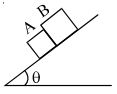
The two blocks $A$ and $B$ of equal mass are initially in contact when released from rest on the inclined plane. The coefficients of friction between the inclined plane $A$ and $B$ are $\mu_1$ and $\mu_2$ respectively.
Given below are two statements:

Statement $I$ : A uniform wire of resistance $80\,\Omega$ is cut into four equal parts. These parts are now connected in parallel. The equivalent resistance of the combination will be $5\,\Omega$.

Statement $II :$ Two resistance $2\,R$ and $3\,R$ are connected in parallel in a electric circuit. The value of thermal energy developed in $3\,R$ and $2\,R$ will be in the ratio $3:2.$

In the light of the above statements, choose the most appropriate answer from the options given below

A river $10\,m$ deep is flowing at $5\,m/s$. The shearing stress between horizontal layers of the river is :- $(\eta  = 10^{-3}\,SI\,unit)$
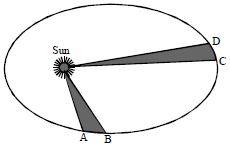
The fig. shows the motion of a planet around the un in an elliptical orbit with sun at the  focus. The shaded areas can be assumed to be equal. If $t_1$ and $t_2$ represent the  time taken for the planet to move from $A$ to $B$ and $C$ to $D$ respectively, then
Two travelling waves of equal amplitudes and equal frequencies move in opposite directions along a string. They interfere to produce a stationary wave whose equation is given by $y=\left(10 \cos \pi x \sin \frac{2 \pi t}{T}\right)\, cm$

The amplitude of the particle at $x =\frac{4}{3} \,cm$ will be........ $cm$.