MCQ
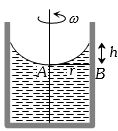
A liquid is kept in a cylindrical vessel which is being rotated about a vertical axis through the centre of the circular base. If the radius of the vessel is $ r $ and angular velocity of rotation is $\omega $, then the difference in the heights of the liquid at the centre of the vessel and the edge is
  • A
    $\frac{{r\omega }}{{2g}}$
  • $\frac{{{r^2}{\omega ^2}}}{{2g}}$
  • C
    $\sqrt {2gr\omega } $
  • D
    $\frac{{{\omega ^2}}}{{2g{r^2}}}$

Answer

Correct option: B.
$\frac{{{r^2}{\omega ^2}}}{{2g}}$
b
(b)From Bernoulli's theorem,
${P_A} + \frac{1}{2}dv_A^2 + dg{h_A} = {P_B} + \frac{1}{2}dv_B^2 + dg{h_B}$
Here, ${h_A} = {h_B}$
$\therefore \;{P_A} + \frac{1}{2}dv_A^2 = {P_B} + \frac{1}{2}dv_B^2$
==> ${P_A} - {P_B} = \frac{1}{2}d[v_B^2 - v_A^2]$
Now, ${v_A} = 0,\;{v_B} = r\omega $ and ${P_A} - {P_B} = hdg$
$\therefore \;\;hdg = \frac{1}{2}d{r^2}{\omega ^2}$ or $h = \frac{{{r^2}{\omega ^2}}}{{2g}}$

Need a full question paper?

Generate a complete, print-ready paper with questions like this in minutes — across 16+ boards, with answer keys.

Start Generating Free

Similar questions

In order to raise a mass of $100\,kg$ a man of mass $60\,kg$ fastens a rope to it and passes the rope over a smooth pulley. He climbs the rope with an acceleration $5g/4$ relative to the rope. The tension in the rope is ....... $N$. $(g = 10\,m/s^2)$
One kilogram of weight is equal to.
In the determination of Young's modulus $\left(Y=\frac{4 MLg }{\pi / d ^2}\right)$ by using Searle's method, a wire of length $L=2 \ m$ and diameter $d =0.5 \ mm$ is used. For a load $M =2.5 \ kg$, an extension $\ell=0.25 \ mm$ in the length of the wire is observed. Quantities $d$ and $\ell$ are measured using a screw gauge and a micrometer, respectively. They have the same pitch of $0.5 \ mm$. The number of divisions on their circular scale is $100$ . The contributions to the maximum probable error of the $Y$ measurement
To break a wire of one meter length, minimum $40 \,kg \,wt$. is required. Then the wire of the same material of double radius and $6 \,m$ length will require breaking weight ....... $kg \,wt$
The displacement $y$ (in $cm$) produced by a simple harmonic wave is $y = \frac{{10}}{\pi }\sin \left( {2000\pi t - \frac{{\pi x}}{{17}}} \right)$. The periodic time and maximum velocity of the particles in the medium will respectively be
Two forces $P$ and $Q$, of magnitude $2F$ and $3F$, respectively, are at an angle $\theta $ with each other. If the force $Q$ is doubled, then their resultant also gets doubled. Then, the angle $\theta $ is ....... $^o$
It is found that $|\text{A}+\text{B}|=|\text{A}|.$ This necessarily implies,
  1. $\text{B}=0$
  2. A, B are antiparallel.
  3. A, B are perpendicular.
  4. $\text{A.B}≤0$
A steel tape is calibrated at $20^{\circ} C$. On a cold day when the temperature is $-15^{\circ} C$, percentage error in the tape will be ........... $\%$ $\left[\alpha_{\text {steel }}=1.2 \times 10^{-5}{ }^{\circ} C ^{-1}\right]$
The equation of a simple harmonic wave is given by $y = 3sin\frac{\pi }{2}\left( {50t - x} \right)\, $ 

where $x$ and $y$ are in metres and $t$ is in seconds. The ratio of maximum particle velocity to the wave velocity is 

A block moving horizontally on a smooth surface with a speed of $40\, {m} / {s}$ splits into two parts with masses in the ratio of $1: 2$. If the smaller part moves at $60\, {m} / {s}$ in the same direction, then the fractional change in kinetic energy is :-