MCQ
A litre of alcohol weighs
  • A
    Less in winter than in summer
  • Less in summer than in winter
  • C
    Some both in summer and winter
  • D
    None of the above

Answer

Correct option: B.
Less in summer than in winter
b
(b) In summer alcohol expands, density decreases, so $1$ litre of alcohol will weigh less in summer than in winter.

Need a full question paper?

Generate a complete, print-ready paper with questions like this in minutes — across 16+ boards, with answer keys.
Start Generating Free

Similar questions

A ball is thrown vertically upward with an initial velocity of $150\,m / s$. The ratio of velocity after $3\,s$ and $5\,s$ is $\frac{x+1}{x}$. The value of $x$ is $...........$ Take $\left(g=10\,m / s ^2\right)$
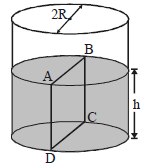
Water is filled up to a height $h$ in a beaker of radius $R$ as shown in the figure. The density of water is $\rho$, the surface tension of water is $T$ and the atmospheric pressure is $P_0$. Consider a vertical section $ABCD$ of the water column through a diameter of the beaker. The force on water on one side of this section by water on the other side of this section has magnitude
The units of modulus of rigidity are
Inertia is that property of a body by virtue of which the body is
One end of a long metallic wire of length $L$ is tied to the ceiling. The other end is tied to massless spring of spring constant $K$. A mass $ m$ hangs freely from the free end of the spring. The area of cross-section and Young's modulus of the wire are $A$ and $Y$ respectively. If the mass is slightly pulled down and released, it will oscillate with a time period $T$ equal to
A particle executes linear simple harmonic motion with an ampilitude of $3\,cm$ . When the particle is at $2\,cm$ from the mean position , the magnitude of its velocity is equal to that of its acceleration. Then its time period in seconds is 
The velocity of the molecules of a gas at temperature $120K$ is $v.$ At what temperature will the velocity be $2v\ ?$
Acceleration of a particle which is at rest at $x = 0 $ is $\vec{\text{a}}=(4-2\text{x})\hat{\text{i}}.$ Select the correct alternative(s):
If ${a_r}$ and ${a_t}$represent radial and tangential accelerations, the motion of a particle will be uniformly circular if
The time period of a simple pendulum when it is made to oscillate on the surface of moon