MCQ
A logic gate is an electronic circuit which
  • Makes logic decisions
  • B
    Allows electrons flow only in one direction
  • C
    Works binary algebra
  • D
    Alternates between $0 $ and $ 1$  values

Answer

Correct option: A.
Makes logic decisions
a
(a) A logic gate is an electronic circuit which Makes logic decisions. $A$ Digital Logic Gate is an electronic device that makes logical decisions based on the different combinations of digital signals present on its inputs. Digital logic gates may have more than one input, ($A,$ $B,$ $C.$etc) but generally only have one digital output, $(Q).$ Individual logic gates can be connected together to form combinational or sequential circuits or larger logic gate functions.A logic gate is an elementary building block of a digital circuit. Most logic gates have two inputs and one output

At any given moment, every terminal is in one of the two binary conditions low $( 0 )$

or high $(1),$ represented by different voltage levels.

So, the correct answer is "Makes logic decisions:

Need a full question paper?

Generate a complete, print-ready paper with questions like this in minutes — across 16+ boards, with answer keys.
Start Generating Free

Similar questions

 A convex lens $'A'$ of focal length $20\, \mathrm{~cm}$ and a concave lens $'B'$ of focal length $5\, \mathrm{~cm}$ are kept along the same axis with a distance $'\mathrm{d}'$ between them. If a parallel beam of light falling on $'A'$ leaves $'B'$ as a parallel beam, then the distance $'d'$ in $cm$ will be :
Approximate thickness of oil film to observe interference of light (due to which it looks coloured) is ....... 
Sun light falls normally on a surface of area $36\,cm ^{2}$ and exerts an average force of $7.2 \times 10^{-9}\,N$ within a time period of $20$ minutes. Considering a case of complete absorption, the energy flux of incident light is.
The ionisation potential of $H-$atom is $13.6\,V$. When it is excited from ground state by monochromatic radiations of $970.6\,{\mathring A}$, the number of emission lines will be (according to Bohr’s theory)
A capacitor of $10\,\mu F$ charged up to $250\, volts$ is connected in parallel with another capacitor of $5\,\mu F$ charged up to $100\, volts$. The common potential is.....$V$
A proton moving with one tenth of velocity of light has a certain de Broglie wavelength of $\lambda$. An alpha particle having certain kinetic energy has the same de-Brogle wavelength $\lambda$. The ratio of kinetic energy of proton and that of alpha particle is:
Two bar magnets with magnetic moments $ 2 M $ and $M$ are fastened together at right angles to each other at their centres to form a crossed system, which can rotate freely about a vertical axis through the centre. The crossed system sets in earth’s magnetic field with magnet having magnetic moment $2M $ making and angle  $ \theta $ with the magnetic meridian such that
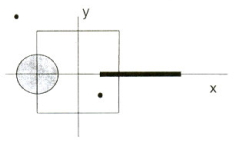
A disk of radius $a / 4$ having a uniformly distributed charge $6 \mathrm{C}$ is placed in the $x-y$ plane with its centre at $(-a / 2,0,0)$. A rod of length $a$ carrying a uniformly distributed charge $8 \mathrm{C}$ is placed on the $x$-axis from $x=a / 4$ to $x=5 a / 4$. Two point charges $-7 \mathrm{C}$ and $3 \mathrm{C}$ are placed at $(a / 4,-a / 4,0)$ and $(-3 a / 4,3 a / 4,0)$, respectively. Consider a cubical surface formed by six surfaces $x= \pm a / 2, y= \pm a / 2$, $z= \pm a / 2$. The electric flux through this cubical surface is
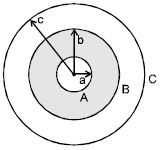
$A$ and $C$ are concentric conducting spherical shells of radius $a$ and $c$ respectively. $A$ is surrounded by a concentric dielectric of inner radius $a$, outer radius $b$ and dielectric constant $k$. If sphere $A$ is given a charge $Q$, the potential at the outer surface of the dielectric is.
The value closest to the thermal velocity of a Helium atom at room temperature $(300\,K)$in $ms^{-1}$ is $[k_B\, = 1 .4\times10^{-23}\,J/K;\, m_{He}\, = 7\times10^{-27}\,kg]$