Question
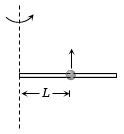
A long horizontal rod has a bead which can slide along its length, and initially placed at a distance $L$ from one end $A$ of the rod. The rod is set in angular motion about $A$ with constant angular acceleration $\alpha$. If the coefficient of friction between the rod and the bead is $\mu$, and gravity is neglected, then the time after which the bead starts slipping is
Answer

(a) Let the bead starts slipping after time$ t$

For critical condition

Frictional force provides the centripetal force

$m{\omega ^2}L = \mu \,R = \mu \,m \times {a_t} = \mu Lm\alpha $

$⇒$ $m{(\alpha t)^2}L = \mu mL\alpha $ $⇒$ $t = \sqrt {\frac{\mu }{\alpha }} $      (As $\omega = \alpha t$)

Need a full question paper?

Generate a complete, print-ready paper with questions like this in minutes — across 16+ boards, with answer keys.

Start Generating Free

Similar questions

For the circuits shown in figures $I$ and $II$, the voltmeter reading would be
A student obtained following observations in an experiment of meter bridge to find the unknown resistance of the circuit The most accurate value of unknown resistance is ............ $\Omega$
S.No. $R$ $l$ $100-l$ $S = \left( {\frac{{100 - l}}{l}} \right)R$
$1$ $20\,\Omega $ $43$ $57$ $26.51\,\Omega $
$2$ $30\,\Omega $ $51$ $49$ $28.82\,\Omega $
$3$ $40\,\Omega $ $59$ $41$ $27.80\,\Omega $
$4$ $60\,\Omega $ $70$ $30$ $25.71\,\Omega $
The dimensions of surface tension are
An expression for rate of heat generated, if a current of $I$ ampere flows through a resistance of $R$ $\Omega$, is
For a compound microscope, the focal lengths of object lens and eye lens are ${f_o}$ and ${f_e}$ respectively, then magnification will be done by microscope when
A ($100\, W$, $200\, V$) bulb is connected to a $160\, V$ power supply. The power consumption would be ............. $W$
A capillary tube made of glass is dipped into mercury. Then
Two balls of equal mass undergo head on collision while each was moving with speed $6 \,m / s$. If the coefficient of restitution is $\frac{1}{3}$, the speed of each ball after impact will be ............ $m / s$
A body of mass $2 \,kg$ is projected vertically upwards with a velocity of $2\,m\,{\sec ^{ - 1}}$. The K.E. of the body just before striking the ground is ............. $\mathrm{J}$
A body is moving in a low circular orbit about a planet of mass $M$ and radius $R$. The radius of the orbit can be taken to be $R$ it self. Then the ratio of the speed of this body in the orbit to the escape velocity from the planet is