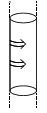
A long solenoid carrying a current produces a magnetic field $B$ along its axis. If the current is doubled and the number of turns per cm is halved, the new value of the magnetic field is
AIPMT 2003,JEE MAIN 2022, Easy
Download our app for free and get started
(a) $B = {\mu _0}ni \Rightarrow \frac{B}{{B'}} = \frac{n}{{n'}} \times \frac{i}{{i'}} = \frac{1}{{(1/2)}} \times \frac{1}{2} = 1 \Rightarrow B' = B$

Download our appand get started for free
Experience the future of education. Simply download our apps or reach out to us for more information. Let's shape the future of learning together!No signup needed.*
Similar Questions
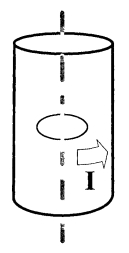
- 1A long circular tube of length $10 \ m$ and radius $0.3 \ m$ carries a current $I$ along its curved surface as shown. A wire-loop of resistance $0.005$ ohm and of radius $0.1 \ m$ is placed inside the tube with its axis coinciding with the axis of the tube. The current varies as $I=I_0 \cos (300 t)$ where $I_0$ is constant. If the magnetic moment of the loop is $N \mu_0 I_0 \sin (300 t)$, then ' $N$ ' isView Solution
- 2An electron in a hydrogen atom revolves around its nucleus with a speed of $6.76 \times 10^6\,ms ^{-1}$ in an orbit of radius $0.52\,\mathring A$. The magnetic field produced at the nucleus of the hydrogen atom is $......T$.View Solution
- 3A moving coil galvanometer has $50$ turns and each turn has an area $2 \times 10^{-4} m ^2$. The magnetic field produced by the magnet inside the galvanometer is $0.02 T$. The torsional constant of the suspension wire is $10^{-4} N m rad ^{-1}$. When a current flows through the galvanometer, a full scale deflection occurs if the coil rotates by $0.2$ rad. The resistance of the coil of the galvanometer is $50 \Omega$. This galvanometer is to be converted into an ammeter capable of measuring current in the range $0-1.0 A$. For this purpose, a shunt resistance is to be added in parallel to the galvanometer. The value of this shunt resistance, in ohms, is. . . . . .View Solution
- 4A circular loop of radius $R$ carries a current $I$. Another circular loop of radius $r(< < R) $ carries a current $i$ and is placed at the centre of the larger loop. The planes of the two circles are at right angle to each other. Find the torque acting on the smaller loop.View Solution
- 5View SolutionA metallic ring with a small cut is held horizontally and a magnet is allowed to fall vertically through the ring then the acceleration of the metallic ring is :
- 6Assertion : A proton and an alpha particle having the same kinetic energy are moving in circular paths in a uniform magnetic field. The radii of their circular paths will be equal.View Solution
Reason : Any two charged particles having equal kinetic energies and entering a region of uniform magnetic field $\overrightarrow B $ in a direction perpendicular to $\overrightarrow B $, will describe circular trajectories of equal radii.
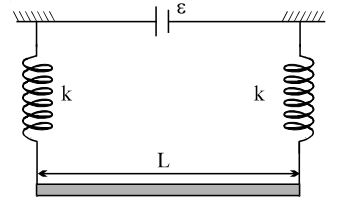
- 7A straight rod of mass $m$ and length $L$ is suspended from the identical spring as shown in the figure. The spring stretched by a distance of $x_0$ due to the weight of the wire. The circuit has total resistance $R\Omega$ . When the magnetic field perpendicular to the plane of the paper is switched on, springs are observed to extend further by the same distance. The magnetic field strength isView Solution
- 8Two identical conducting wires $A$ and $B$ of same dimensions and same material are bent in the form of circular coil. Wire $A$ consists of single turn whereas wire $B$ consists of $2\, turns$. Both these wires are then suspended in a uniform magnetic field with their planes parallel to the one another and same current is passed through them. Which statement is correct ?View Solution
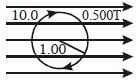
- 9A single circular loop of radius $1.00\, m$ carries a current of $10.0\, mA$. It is placed in $a$ uniform magnetic field of magnitude $0.500\, T$ that is directed parallel to the plane of the loop as suggested in the figure. The magnitude of the torque exerted on the loop by the magnetic field is.View Solution
- 10A hollow cylinder having infinite length and carrying uniform current per unit length $\lambda$ along the circumference as shown. Magnetic field inside the cylinder isView Solution