Question
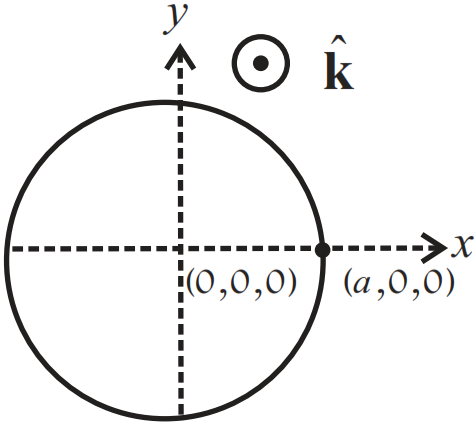
A magnetic field in a certain region is given by $\text{B}=\text{B}_0\cos(\omega\text{t})\hat{\text{k}}$ and a coil of radius a with resistance R is placed in the x-y plane with its centre at the origin in the magnetic field (see Fig). Find the magnitude and the direction of the current at (a, 0, 0) at $\text{t}=\frac{\pi}{2\omega},\text{t}=\frac{\pi}{\omega} \text{ and }\text{t}=\frac{3\pi}{2\omega}$.
Answer

Key concept:
First law: When ever the number of magnetic lines of force(magnetic flux) passing through a circuit changes, an emf is produced in the circuit called induced emf. The induced emf persists only as long as there is a change or cutting of flux.
Second law: The induced emf is given by the rate of change of magnetic flux linked with the circuit, i.e., $\text{e}=-\frac{\text{d}\phi}{\text{dt}}$. For n Turns $\text{e}=-\frac{\text{N d}\phi}{\text{dt}}$; Negative sign indicates that induced emf (e) apposes the change of flux.
First we need to find out the flux passing through the rign at any instant and that is given by
$\phi_\text{m}-\vec{\text{B}}.\vec{\text{A}}=\text{BA}\cos\theta$
And as we know both $\vec{\text{A}}$ (area vector) and $\vec{\text{B}}$ (magnetic field vector) are directed along z-axis. So, angle between them is 0.
So, $\cos\theta=1\ (\because\ \theta=0)$
$\Rightarrow\ \phi_\text{m}=\text{BA}$
Area of coil of radius $\text{a}=\pi\text{a}^2$
$\in=\text{B}_0(\pi\text{a}^2)\cos\omega\text{t}$
By Faraday's law of eletromagnetic induction,
Magnitude of induced emf is given by
$\in=\text{B}_0(\pi\text{a}^2)\omega\sin\omega\text{t}$
This causes flow of induced emf is given by
$\text{I}=\frac{\text{B}_0(\pi\text{a}^2)\omega\sin\omega\text{t}}{\text{R}}$
Now, the value of current at different instants,
  1. $\text{t}=\frac{\pi}{2\omega}$
$\text{I}=\frac{\text{B}_0(\pi\text{a}^2)\omega}{\text{R}}\text{ along}\hat{\text{j}}$

Because $\sin\omega\text{t}=\sin\Big(\omega\frac{\pi}{2\omega}\Big)=\sin\frac{\pi}{2}=1$
  1. $\text{t}=\frac{\pi}{\omega},\text{I}=\frac{\text{B}_0(\pi\text{a}^2)\omega}{\text{R}}=0$
$\sin\omega\text{t}=\sin\Big(\omega\frac{\pi}{\omega}\Big)=\sin{\pi}=0$
  1. $\text{t}=\frac{3}{2}\frac{\pi}{\omega}$
$\text{I}=\frac{\text{B}(\pi\text{a}^2)\omega}{\text{R}}\text{along}-\hat{\text{j}}$

$\sin\omega\text{t}=\sin\Big(\omega.\frac{3\pi}{2\omega}\Big)=\sin\frac{3\pi}{2}=-1$

Need a full question paper?

Generate a complete, print-ready paper with questions like this in minutes — across 16+ boards, with answer keys.

Start Generating Free

Similar questions

A narrow beam of singly charged potassium ions of kinetic energy 32keV is injected into a region of width 1.00cm with a magnetic field of strength 0.500T, as shown in the figure. The ions are collected at a screen 95.5cm away from the field region. If the beam contains isotopes of atomic weights 39 and 41, find the separation between the points where these isotopes strike the screen. Take the mass of a potassium ion $= A (1.6 \times 10^{-27})kg$, where A is the mass number.
Two identical pith balls are charged by rubbing against each other. They are suspended from a horizontal rod through two strings of length 20cm each, the separation between the suspension points being 5cm. In equilibrium, the separation between the balls is 3cm. Find the mass of each ball and the tension in the strings. The charge on each ball has a magnitude $2.0 \times 10^{-8}C.$
Suppose India had a target of producing by 2020 AD, 200,000 MW of electric power, ten percent of which was to be obtained from nuclear power plants. Suppose we are given that, on an average, the efficiency of utilization (i.e. conversion to electric energy) of thermal energy produced in a reactor was 25%. How much amount of fissionable uranium would our country need per year by 2020? Take the heat energy per fission of $^{235}\text{U}$ to be about 200MeV.
A uniform magnetic field B exist in a region. An electron projected perpendicular to the field goes in a circle. Assuming Bohr's quantization rule for angular momentum, calculate (a) the smallest possible radius of the electron (b) the radius of the nth orbit and (c) the minimum possible speed of the electron.
Two charges -q each are separated by distance 2d. A third charge +q is kept at mid point O. Find potential energy of +q as a function of small distance x from O due to -q charges. Sketch P.E. v/s x and convince yourself that the charge at O is in an unstable equilibrium.
Explain direct current direct emf and draw their graphs. Define alternating current and explain in detail.
Two identical pith balls, each carrying a charge q, are suspended from a common point by two strings of equal length l. Find the mass of each ball if the angle between the strings is $2\theta$ in equilibrium.
Two charges q and -3q are placed fixed on x-axis separated by distance 'd'. Where should a third charge 2q be placed such that it will not experience any force?
Figure shows a smooth track which consists of a straight inclined part of length 1 joining smoothly with the circular part. A particle of mass m is projected up the incline from its bottom.
  1. Find the minimum projection-speed $v_0$, for which the particle reaches the top of the track.
  2. Assuming that the projection-speed is $2v_0 $ and that the block does not lose contact with the track before reaching its top, find the force acting on it when it reaches the top.
  3. Assuming that the projection-speed is only slightly greater than $v_0$, where will the block lose contact with the track?
Find the currents through the resistances in the circuits shown in figure.