Question
A magnetic field set up using Helmholtz coils (described in Exercise 4.16) is uniform in a small region and has a magnitude of 0.75 T. In the same region, a uniform electrostatic field is maintained in a direction normal to the common axis of the coils. A narrow beam of (single species) charged particles all accelerated through 15 kV enters this region in a direction perpendicular to both the axis of the coils and the electrostatic field. If the beam remains undeflected when the electrostatic field is $9.0 \times 10^{–5} V m^{–1},$ make a simple guess as to what the beam contains. Why is the answer not unique?
Answer

Magnetic field, B = 0.75 T
Accelerating voltage, $V = 15\ kV = 15 \times 10^3\ V$
Electrostatic field, $E = 9.0 \times 10^{-5}\ V\ m^{-1}$
Mass of the electron = m
Charge of the electron = e
Velocity of the electron = v
Kinetic energy of the electron = eV
$\Rightarrow\frac{1}{2}\text{mv}^{2}=\text{eV}$
$\therefore\frac{\text{e}}{\text{m}}=\frac{\text{v}^{2}}{2\text{V}}....(1)$
Since the particle remains undeflected by electric and magnetic fields, we can infer that the electric field is balancing the magnetic field.
$\therefore\text{eE}=\text{evB}$
$\text{v}=\frac{\text{E}}{\text{B}}...........(2)$
Putting equation (2) in equation (1), we get;
$\frac{\text{e}}{\text{m}}=\frac{1}{2}\frac{\Big(\frac{\text{E}}{\text{B}}\Big)^{2}}{\text{V}}=\frac{\text{E}^{2}}{2\text{VB}^{2}}$
$=\frac{(9.0\times10^{5})^{2}}{2\times15000\times(0.75)^{2}}$
$=4.8\times10^{7}\text{C/ kg}$
This value of specific charge e/m is equal to the value of deuteron or deuterium ions. This is not a unique answer. Other possible answers are $He^{++}, Li^{++},$ etc.

Need a full question paper?

Generate a complete, print-ready paper with questions like this in minutes — across 16+ boards, with answer keys.

Start Generating Free

Similar questions

A long bar magnet has a pole strength of 10A-m. Find the magnetic field at a point on the axis of the magnet at a distance of 5cm from the north pole of the magnet.
An amount n (in moles) of a monatomic gas at an initial temperature $T_0$ is enclosed in a cylindrical vessel fitted with a light piston. The surrounding air has a temperature $T_s(> T_0)$ and the atmospheric pressure is $P_a.$ Heat may be conducted between the surrounding and the gas through the bottom of the cylinder. The bottom has a surface area A, thickness x and thermal conductivity K. Assuming all changes to be slow, find the distance moved by the piston in time t.
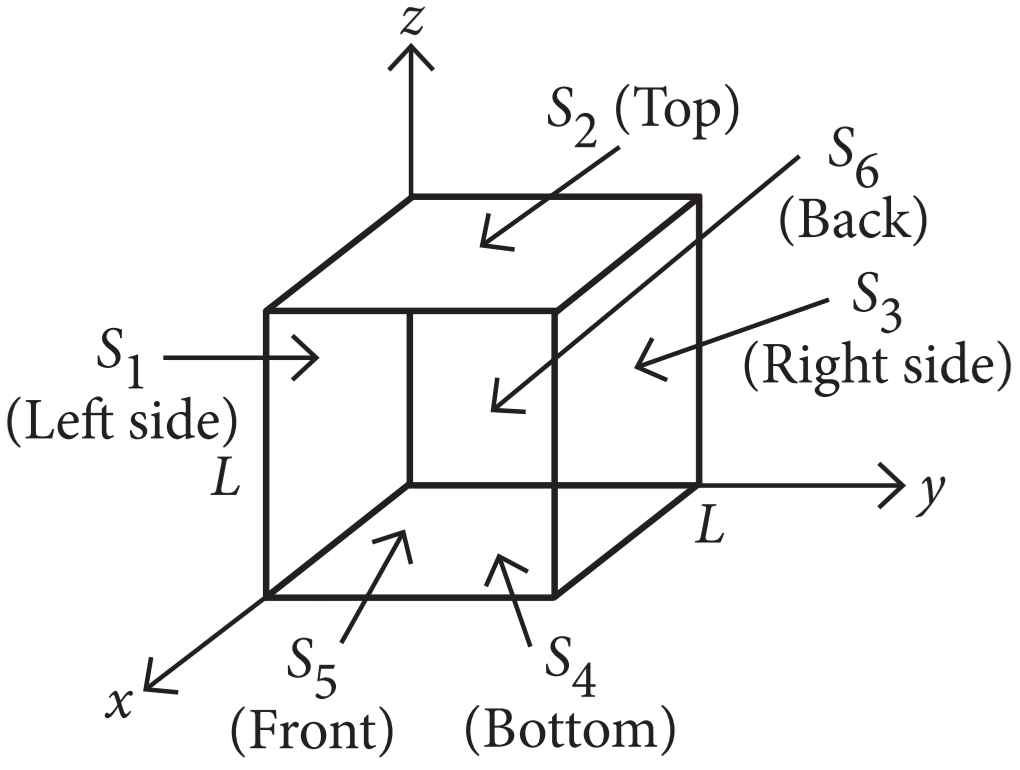
Net electric flux through a cube is the sum of fluxes through its six faces. Consider a cube as shown in figure, having sides of length L = 10.0cm. The electric field is uniform, has a magnitude $E = 4.00 \times 10^3N C^{-1}$ and is parallel to the xy plane at an angle of 37º measured from the + x - axis towards the + y - axis.
  1. Electric flux passing through surface $S_6$ is:
  1. $-24N\ m^2C^{-1}$
  2. $24N\ m^2C^{-1}$
  3. $32N\ m^2C^{-1}$
  4. $-32N\ m^2C^{-1}$
  1. Electric flux passing through surface $S_1$ is:
  1. $-24N\ m^2C^{-1}$
  2. $24N\ m^2 C^{-1}$
  3. $32N\ m^2 C^{-1}$
  4. $-32N\ m^2 C^{-1}$
  1. The surfaces that have zero flux are:
  1. $S_1$ and $S_3$
  2. $S_5$ and $S_6$
  3. $S_2$ and $S_4$
  4. $S_1$ and $S_2$
  1. The total net electric flux through all faces of the cube is:
  1. 8N $m^2\ C^{-1}$
  2. -8N $m^2\ C^{-1}$
  3. 24N $m^2\ C^{-1}$
  4. Zero.
  1. The dimensional formula of surface integral $\oint\vec{\text{E}}\cdot\text{d}\vec{\text{S}}$ of an electric field is:
  1. $[M\ L^2T^{-2} A^{-1}]$
  2. $[M\ L^3T^{-3} A^{-1}]$
  3. $[M\ L^{-1}T^3 A^{-3}]$
  4. $[M\ L^{-3}T^{-3} A^{-1}]$

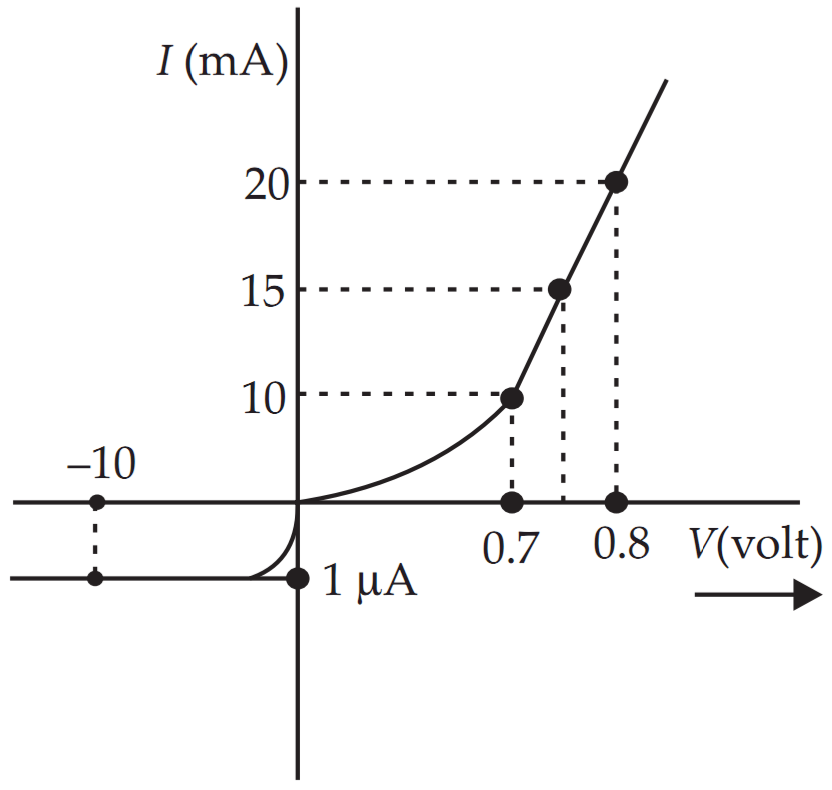
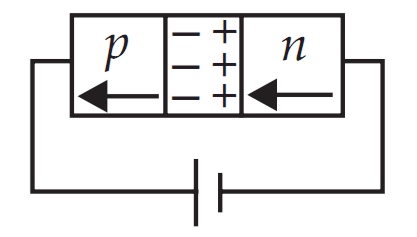
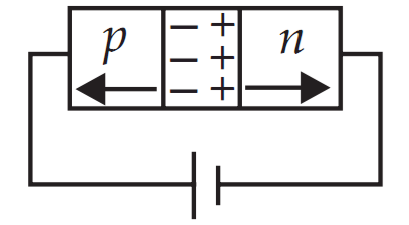
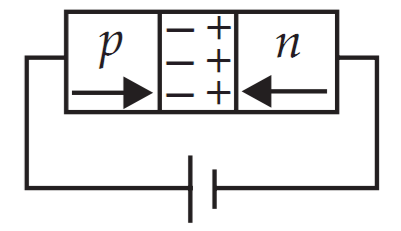
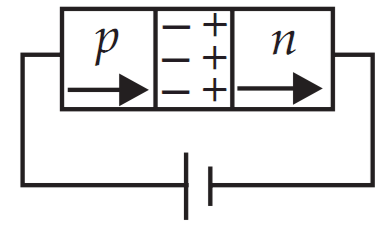
When the diode is forward biased, it is found that beyond forward voltage $V = V_k,$ called knee voltage, the conductivity is very high. At this value of battery biasing for p-n junction, the potential barrier is overcome and the current increases rapidly with increase in forward voltage.
When the diode is reverse biased, the reverse bias voltage produces a very small current about a few microamperes which almost remains constant with bias. This small current is reverse saturation current.
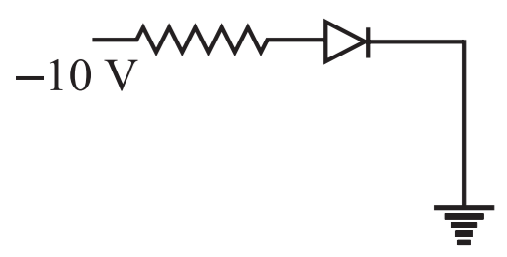
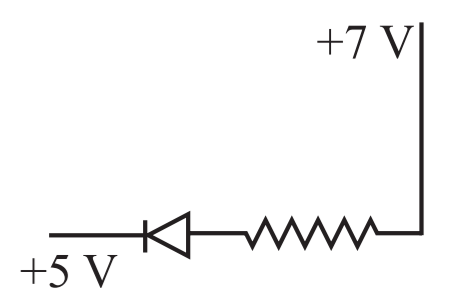
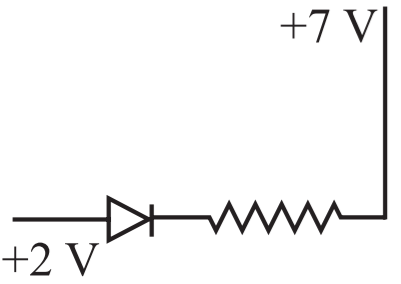
  1. In which of the following figures, the p-n diode is forward biased.
  1.  
  1.  
  1.  
  1.  
  1. Based on the V-I characteristics of the diode, we can classify diode as:
  1. Bi-directional device.
  2. Ohmic device.
  3. Non-ohmic device.
  4. Passive element.
  1. The V-Icharacteristic of a diode is shown in the figure. The ratio of forward to reverse bi as resistance is:
  1. $100$
  2. $10^6$
  3. $10$
  4. $10^{-6}$
  1. In the case of forward biasing of a p-n junction diode, which one of the following figures correctly depicts the direction of conventional current (indicated by an arrow mark)?
  1.  
  1.  
  1.  
  1.  
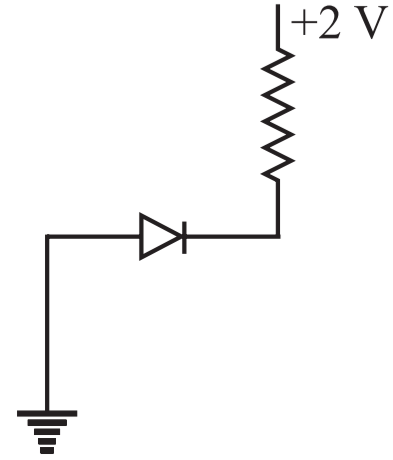
  1. If an ideal junction diode is connected as shown, then the value of the current I is:
  1. 0.013A
  2. 0.02A
  3. 0.01A
  4. 0.1A
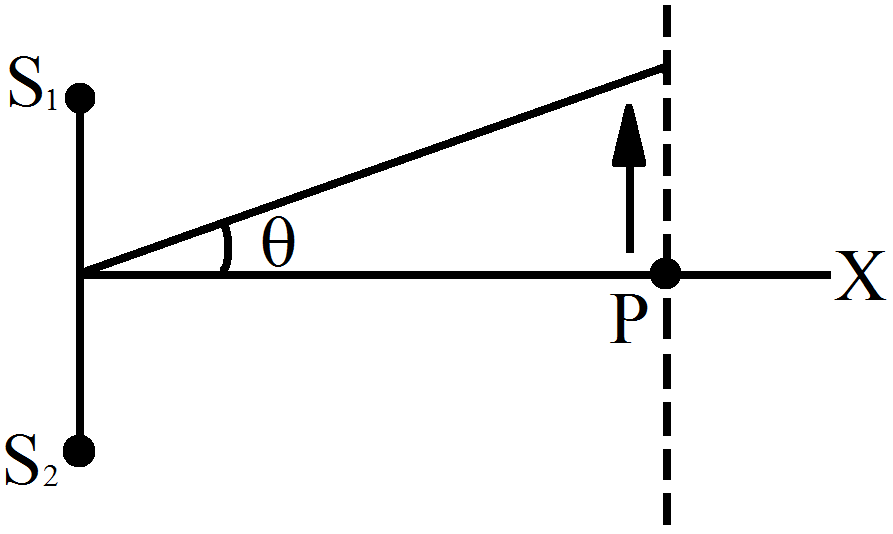
Two speakers $S_1$ and $S_2$, driven by the same amplifier, are placed at y = 1.0m and y = -1.0m figure, The speakers vibrate in phase at 600Hz. A man stands at a point on the X-axis at a very large distance from the origin and starts moving parallel to the Y-axis. The speed of sound in air is 330m/s.
  1. At what angle $\theta$ will the intensity of sound drop to a minimum for the first time?
  2. At what angle will he hear a maximum of sound intensity for the first time?
  3. If he continues to walk along the line, how many more maxima can he hear?
Two point charges +9e and +e are located at a distance of 16 cm apart from each other. Where should a charge q be placed between them so that there is no force on it?
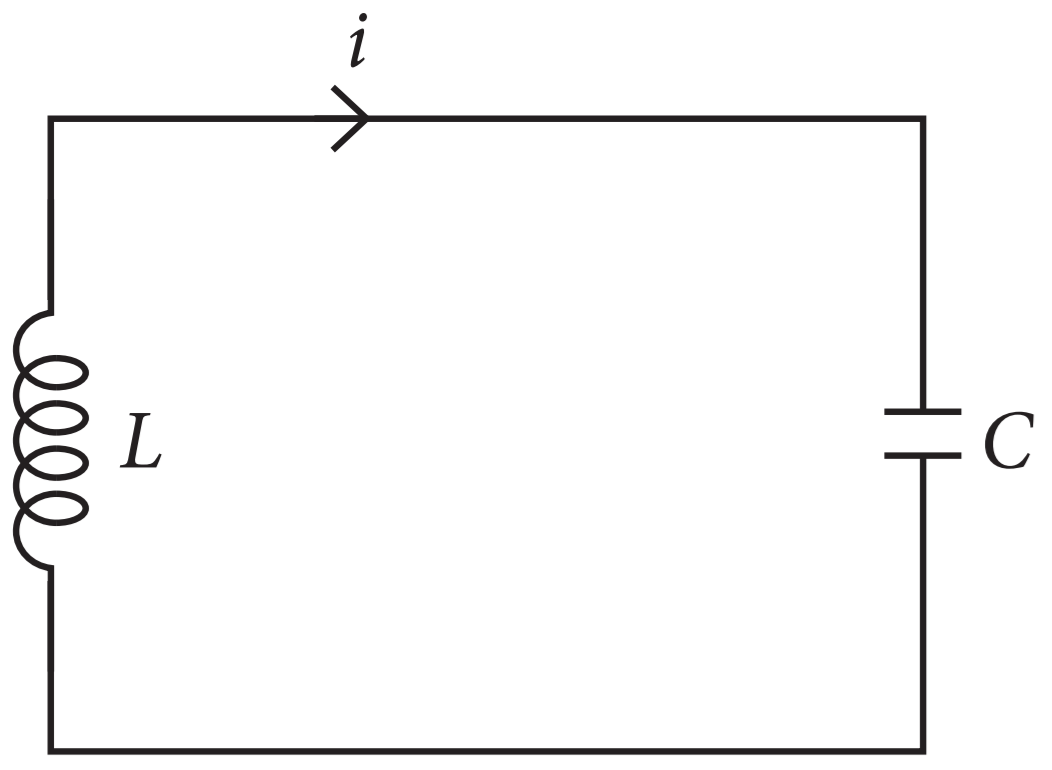
An LC circuit also called a resonant circuit, tank circuit or tuned circuit is an electric circuit consisting of an inductor represented by the letter Land a capacitor, represented by the letter C connected together. An LC circuit is an idealized model since it assumes there is no dissipation of energy due to resistance. An LC circuit contains a 20mH inductor and a $50\mu\text{F}$ capacitor with an initial charge of 10mC. The resistance of the circuit is negligible. Let the instant the circuit is closed bet = 0.
  1. The total energy stored initially is:
  1. 5J
  2. 3J
  3. 10J
  4. 1J
  1. The natural frequency of the circuit is:
  1. 159.24Hz
  2. 200.12Hz
  3. 110.25Hz
  4. 95Hz
  1. At what time is the energy stored completely electrical?
  1. $0, 5\text{T}, 9\text{T}$
  2. $0,\text{T}, 2\text{T}, 3\text{T}$
  3. $\frac{\text{T}}{2},\frac{\text{5T}}{2},\frac{\text{9T}}{2}$
  4. $0,\frac{\text{T}}{2},{\text{T}},\frac{\text{3T}}{2}$
  1. At what time is the energy stored completely magnetic?
  1. $\frac{\text{T}}{2},\frac{\text{3T}}{2},\frac{\text{T}}{4}$
  2. $\frac{\text{T}}{3},\frac{\text{T}}{9},\frac{\text{T}}{12}$
  3. $0, 2\text{T}, 3\text{T}$
  4. $\frac{\text{T}}{4},\frac{\text{3T}}{4},\frac{\text{5T}}{4}$
  1. The value of $X_L$ is:
  1. $20\Omega$
  2. $40\Omega$
  3. $60\Omega$
  4. $50\Omega$
Sunita and her friends visited an exhibition. The policeman asked them to pass through a metal detector. Sunita’s friends were initially scared of it. Sunita, however, explained to them the purpose and working of the metal detector.
Answer the following questions:
  1. On what principle does a metal detector work?
  2. Why does the detector emit sound when a person carrying any metallic object walks through it?
  3. State any two qualities which Sunita displayed while explaining the purpose of walking through the detector.
A tangent galvanometer shows a deflection of 45° when 10mA of current is passed through it. If the horizontal component of the earth's magnetic field is $B_H = 3.6\times 10^{-5} T$ and radius of the coil is 10cm, find the number of turns in the coil.
According to wave theory, the tight of any frequency can emit electrons from metallic surface provided the intensity of light be sufficient to provided necessary energy for emission of electrons, but according to experimental observations, the light of frequency less than threshold frequency can not emit electrons; whatever be the intensity of incident light. Einstein also proposed that electromagnetic radiation is quantised. If photoelectrons are ejected from a surface when light of wavelength $\lambda_1=550\text{nm}$ is incident on it. The stopping potential for such electrons is $V_s = 0.19V$. Suppose the radiation of wavelength $\lambda_2=190\text{nm}$ is incident on the surface.
  1. Photoelectric effect supports quantum nature oflight because.
  1. There is a minimum frequency of light below which no photoelectrons are emitted.
  2. The maximum K.E. of photoelectric depends only on the frequency oflight and not on its intensity.
  3. Even when the metal surface is faintly illuminated, the photo electrons leave the surface immediately.
  4. Electric charge of the photoelectrons is quantized.
  1. A, B, C
  2. B, C
  3. C, D
  4. A, D, C
  1. ln photoelectric effect, electrons are ejected from metals, if the incident light has a certain minimum.
  1. Wavelength.
  2. Frequency.
  3. Amplitude.
  4. Angle of incidence.
  1. Calculate the stopping potential $\text{V}_{\text{s}_2}$ of surface.
  1. $4.47$
  2. $3.16$
  3. $2.76$
  4. $5.28$
  1. Calculate the work function of the surface.
  1. $3.75$
  2. $2.07$
  3. $4.20$
  4. $3.60$
  1. Calculate the threshold frequency for the surface.
  1. $500 \times 10^{12}Hz$
  2. $480 \times 10^{13}Hz$
  3. $520 \times 10^{11}Hz$
  4. $460 \times 10^{13}Hz$