Question
A man borrows $Rs.20000$ at $10\%$ per annum compound interest payable annually. If he repays $Rs.5000$ at the end of the first year and $Rs.10000$ at the end of the second year; how much should he pay at the end of the third year in order to clear the account? Find the answer correct to the nearest rupee.
Answer

For $1^{\text {st }}$ half year: $P = Rs \cdot 2000, R =10 \%$ and $T =1$ year
Interest $=\text { Rs. } \frac{20000 \times 10 \times 1}{100}$
$=\text { Rs. } 2000$
Amount
$=\text { Rs. } 20000+R s .2000$
$=\text { Rs. } 22000$
Money paid at the end of $1^{\text {st }}$ half year $=R s .5000$
Balance money for $2^{\text {nd }}$ half year
$=\text { Rs. } 22000-R s .5000$
$=\text { Rs. } 17000$
For $2^{\text {nd }}$ half year: $P=R s .17000 ; R=10 \%$ and $T=1$ year
Interest$ =\text { Rs. } \frac{17000 \times 10 \times 1}{100}$
$=\text { Rs. } 1700$
Amount
$=\text { Rs. } 17000+\text { Rs. } 1700$
$=\text { Rs. } 18700$
Money paid at the end of $2^{\text {nd }}$ half year $=$ Rs. 10000
Balance money for $3^{\text {rd }}$ half year
$=\text { Rs. } 18700-\text { Rs. } 10000$
$=\text { Rs. } 8700$
For $3^{\text {rd }}$ half year: $P=R s .8700 ; R=10 \%$ and $T=1$ year
$\text { Interest }=\text { Rs. } \frac{8700 \times 10 \times 1}{100}$
$=\text { Rs. } 870$
Amount
$=\text { Rs. } 8700+R s .870$
$=R s .9570$
A man should pay $Rs. 9570$ at the end of $3^{\text {rd }}$ year to clear the account.

Need a full question paper?

Generate a complete, print-ready paper with questions like this in minutes — across 16+ boards, with answer keys.

Start Generating Free

Similar questions

Insert three rational numbers between:$0$ and $1$
Simplify the following:$\left\{\left( a ^{ m }\right)^{ m -\frac{1}{ m }}\right\}^{\frac{1}{ m +1}}$
In the following, find the values of $a$ and $b:\frac{7 \sqrt{3}-5 \sqrt{2}}{4 \sqrt{3}+3 \sqrt{2}}=a-b \sqrt{6}$
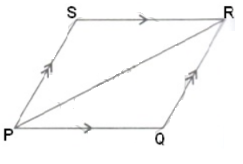
$\text{PQR}$ is a triangle formed by the adjacent sides $PQ$ and $QR$ and diagonal $PR$ of a parallelogram $\text{PQRS}$. If in $\triangle PQR, \angle P : \angle Q : \angle R = 3 : 8 : 4$, Calculate the measures of all the angles of parallelogram $\text{PQRS}.$
Image ​​​​​​​
For solving pair of equation, in this exercise use the method of elimination by equating coefficients :$\frac{x-y}{6}=2(4-x);2 x+y=3(x-4)$
 
Simplify the following :$\frac{6}{2 \sqrt{3}-\sqrt{6}}+\frac{\sqrt{6}}{\sqrt{3}+\sqrt{2}}-\frac{4 \sqrt{3}}{\sqrt{6}-\sqrt{2}}$
Draw the graph of the lines represented by the equations $3x - 2y = 4$ and $x + y = 3$ on the same graph. Find the coordinates of the point where they intersect. State, whether the lines are perpendicular to each other.
Solve the following pairs of equations$:\frac{6}{x+y}=\frac{7}{x-y}+3;\frac{1}{2(x+y)}=\frac{1}{3(x-y)}$,Where $x+y \neq 0$ and $x-y \neq 0$
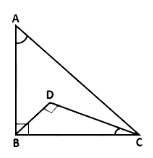
In a right$-$angled $\triangle ABC, \angle B = 90^\circ , BD = 3, DC = 4$, and $AC = 13$. A point $D$ is inside the triangle such as $\angle BDC = 90^\circ .$
Image
Find the values of $3 - 2 \cos \angle BAC + 3 \cot \angle BCD$
$\text{PQRS}$ is a parallelogram. $M$ and $N$ are the mid$-$points of the adjacent sides $QR$ and $RS. O$ is the mid$-$point of the diagonal $PR$. Prove that $\text{MONR}$ is a rectangle and $MN$ is half of $PR.$