Question
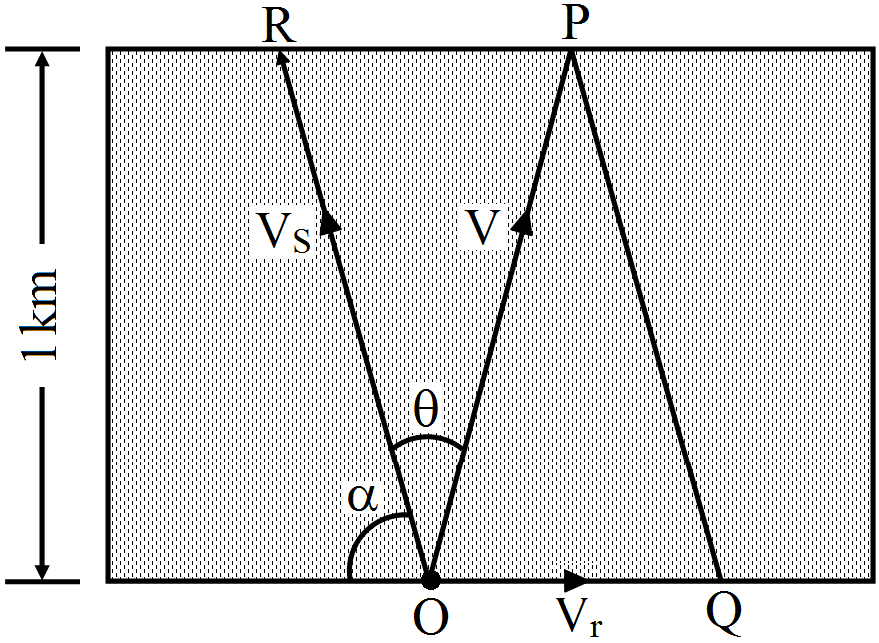
A man can swim at the rate of $5km/ h$ in still water. A river $1km$ wide flows at the rate of $3km/ h$. A swimmer wishes to cross the river straight.
  1. Along what direction must he strike?
  2. What should be his resultant velocity?
  3. How much time he would take to cross?
Answer


Width of the river, $d = 1km$
Velocity of swimmer, $v_s = 5km/ h$
Velocity of water flowing in river,
$v_r = 3km/ h$ along OQ.
  1. The swimmer wants to cross the river straight if the resultant velocity of the river flow and swimmer acts perpendicular to the direction of the river flow i.e. along OP. This will be so if the swimmer moves making an angle a with upstream i.e. along OR.
​​​​​​​But, $\alpha+\theta=90^\circ$ or $\theta=90^\circ-\alpha$
From $\triangle\text{OPR},$ we have
$\sin\theta=\sin(90^\circ-\alpha)=\cos\alpha$
$=\frac{\text{RP}}{\text{RO}}=\frac{3}{5}=0.6$
$\therefore\ \cos\alpha=\cos53^\circ8'$
$\Rightarrow\ \alpha=53^\circ8'\ \text{upstream}$
  1. The resultant velocity along OP is given by
​​​​​​​$\text{v}=\sqrt{\text{v}^2_\text{s}-\text{v}^2_\text{r}}=\sqrt{5^2-3^2}=4\text{km/h}$
  1. Time taken by swimmer to cross the river
​​​​​​​$\text{t}=\frac{\text{d}}{\text{v}}=\frac{1}{4}=0.25\text{h}=15\text{ min}$

Need a full question paper?

Generate a complete, print-ready paper with questions like this in minutes — across 16+ boards, with answer keys.

Start Generating Free

Similar questions

The volume of a liquid flowing out per second of a pipe of length l and radius r is written by a student as,$\text{v}=\frac{\pi}{8}\frac{\text{Pr}^4}{\eta\text{l}}$
where P is the pressure difference between the two ends of the pipe and $\eta$ is coefficent of viscosity of the liquid having dimensional formula $ML^{-1} T^{-1}$. Check whether the equation is dimensionally correct.
Consider the situation of the previous problem. Define displacement resistance $\text{R}_\text{d}=\frac{\text{V}}{\text{i}_\text{d}}$ of the space between the plates, where V is the potential difference between the plates and $i_d$ is the displacement current. Show that $R_d$ varies with time as $\text{R}_\text{d}=\text{R}\big(\text{e}^{\text{t}/\tau}-1\big)$
The surface density (mass/ area) of a circular disc of radius a depends on the distance from the centre as p(r) = A + Br. Find its moment of inertia about the line perpendicular to the plane of the disc through its centre.
Two parallel rail tracks run north-south. Train A moves north with a speed $54 km / h ^{-1}$ and $\operatorname{train} B$ moves south with a speed of $90 km / h ^{-1}$. What is the:
i. Velocity of $B$ with respect to $A$ ?
ii. Velocity of ground with respect to B?
iii. Velocity of a monkey running on the roof of train $A$ against its motion (with a speed of $10 km^{-1}$ with respect to train A ) as observed by a man standing on the ground?
OR
Obtain any one equation of motion for constant acceleration using method of calculus.
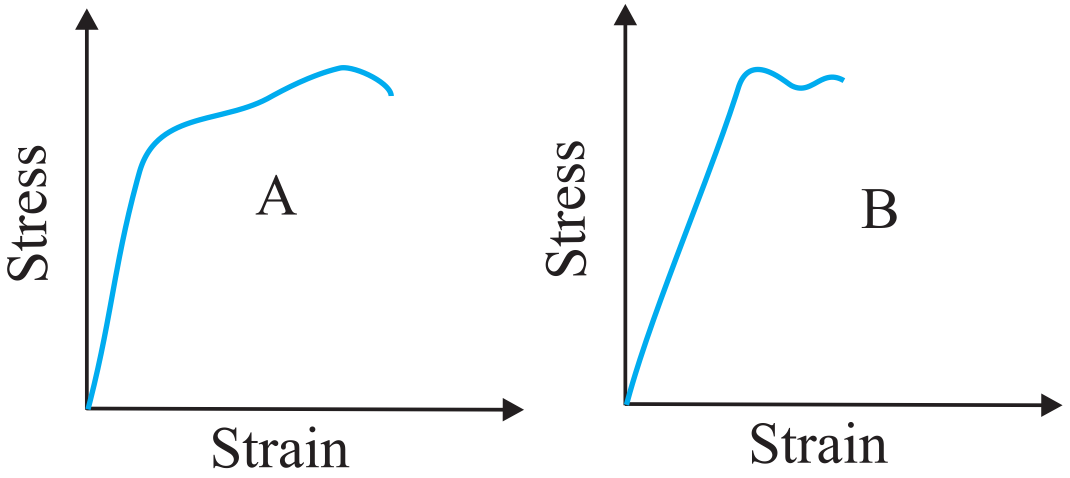
The stress-strain graphs for materials $A$ and $B$ are shown in Fig. The graphs are drawn to the same scale.
  1. Which of the materials has the greater Young’s modulus?
  2. Which of the two is the stronger material?
Calculate the magnetic dipole moment corresponding to the motion of the electron in the ground state of a hydrogen atom.
A cricket bowler releases the ball in two different ways.
  1. Giving it only horizontal velocity, and
  2. Giving it horizontal velocity and a small downward velocity. The speed $v_s$ at the time of release is the same. Both are released at a height $H$ from the ground. Which one will have greater speed when the ball hits the ground? Neglect air resistance.
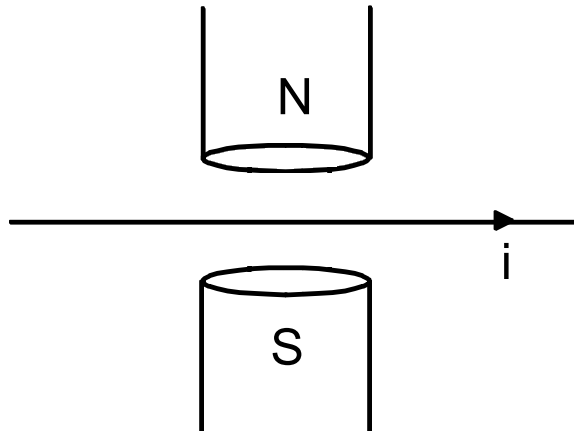
A magnetic field of strength 1.0T is produced by a strong electromagnet in a cylindrical region of radius 4.0cm, as shown in the figure. A wire, carrying a current of 2.0A, is placed perpendicular to and intersecting the axis of the cylindrical region. Find the magnitude of the force acting on the wire.
Three objects of equal mass $M$ are located at the vertices of an equilateral triangle of side $a$. At what speed should the three bodies be rotated on a circle so that the triangle moves on the circumference of the circular chamber and the side of the triangle remains unchanged.
A tuning fork A, marked 512Hz, produces 5 beats per second, where sounded with another unmarked tuning fork B. If B is loaded with wax the number of beats is again 5 per second. What is the frequency of the tuning fork B when not loaded?