Question
 A man is looking at a small object placed at his near point. Without altering the position of his eye or the object, he puts a simple microscope of magnifying power 5X before his eyes. The angular magnification achieved is:
  1. 5
  2. 2.5
  3. 1
  4. 0.2

Answer

  1. 1
Explanation:

We have,

h = Object height

u = Object distance = 25cm

D = Near point = 25cm

Now,

$\text{m}=\frac{\frac{\text{h}}{\text{u}}}{\frac{\text{h}}{\text{D}}}$
$\Rightarrow\text{m}=\frac{\frac{\text{h}}{25}}{\frac{\text{h}}{25}}$
$\Rightarrow \text{m}=1$

Need a full question paper?

Generate a complete, print-ready paper with questions like this in minutes — across 16+ boards, with answer keys.

Start Generating Free

Similar questions

Aball is thrown vertically down with velocity of $5m/s$. With what velocity should another ball be thrown down after $2$ seconds so that it can hit the $1^{st}$ ball in $2$ seconds.........$m/s$
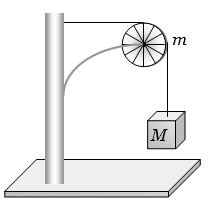
A string of negligible mass going over a clamped pulley of mass m supports a block of mass M as shown in the figure. The force on the pulley by the clamp is given by
Given that $1\,g$ of water in liquid phase has volume $1\,cm^3$ and in vapour phase $1671\, cm^3$ at atmospheric pressure and the latent heat of vaporization of water is $2256\,J/g;$ the change in the internal energy in joules for $1\,g$ of water at $373\,K$ when it changes from liquid phase to vapour phase at the same temperature is ....... $J$
Motion of a ball bearing inside a smooth curved bowl, when released from a point slightly above the lower point is:
A constant power delivering machine has towed a box, which was initially at rest, along a horizontal straight line. The distance moved by the box in time $'t'$ is proportional to
Which of the following statements is correct for any thermodynamic system
A chain of length $L$ rests on a rough table. If $\mu $ be the coefficient of friction, the maximum friction of the chain that can hang over the table will be
The unit vector parallel to the resultant of the vectors $\vec A = 4\hat i + 3\hat j + 6\hat k$ and $\vec B = - \hat i + 3\hat j - 8\hat k$ is
A charged particle moves in a uniform magnetic field. The velocity of the particle at some instant makes an acute angle with the magnetic field. The path of the particle will be:
  1. A straight line.
  2. A circle.
  3. A helix with uniform pitch.
  4. A helix with nonuniform pitch.
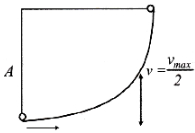
A particle starts with $S.H.M.$ from the mean position as shown in the figure. Its amplitude is $A$ and its time period is $T$. At one time, its speed is half that of the maximum speed. What is this displacement?