MCQ
A man is looking at a small object placed at his near point. Without altering the position of his eye or the object, he puts a simple microscope of magnifying power $5X$ before his eyes. The angular magnification achieved is:
  • A
    $5$
  • B
    $2.5$
  • $1$
  • D
    $0.2$

Answer

Correct option: C.
$1$
We have,
$h =$ Object height
$u =$ Object distance $= 25cm$
$D =$ Near point $= 25cm$
Now,
$\text{m}=\frac{\frac{\text{h}}{\text{u}}}{\frac{\text{h}}{\text{D}}}$
$\Rightarrow\text{m}=\frac{\frac{\text{h}}{25}}{\frac{\text{h}}{25}}$
$\Rightarrow \text{m}=1$

Need a full question paper?

Generate a complete, print-ready paper with questions like this in minutes — across 16+ boards, with answer keys.

Start Generating Free

Similar questions

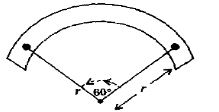
A bar magnet of length $'l'$ and magnetic dipole moment $'M'$ is bent in the form of an arc as shown in figure. The new magnetic dipole moment will be
What is increased in step-down transformer
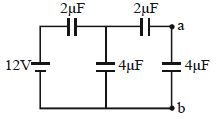
Find the potential difference $V_a -V_b$ between the points $a$ and $b$ shown in each  part of the figure.
A circular plate of diameter $d$ is kept in contact with a square plate of edge $d$ as show in figure. The density of the material and the thickness are same everywhere. The centre of mass of the composite system will be:
Two monochromatic light beams of intensity $16$ and $9$ units are interfering . The ratio of intensities of bright and dark parts of the resultant pattern is
At any instant the ratio of the amount of radioactive substances is 2 : 1. If their half lives be respectively 12 and 16 hours, then after two days, what will be the ratio of the substances
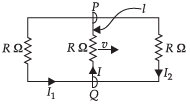
A rectangular loop has a sliding connector $PQ$ of length $l$ and resistance $R\ \Omega$ and it is moving with a speed $v$ as shown. The set-up is placed in a uniform magnetic field going into the plane of the paper. The three currents $I_1 , I_2$ and $I$ are
The power factor of $LCR$ circuit at resonance is
The escape speed of an electron launched from the surface of a glass sphere of diameter $1\ cm$ that has been charged to $10\ nC$ is $x \times 10^7\ m/sec$ . The value of $x$ is 
An electron collides with a free molecule initially in its ground state. The collision leaves the molecule in an excited state that is metastable and does not decay to the ground state by radiation. Let $K$ be the sum of the initial kinetic energies of the electron and the molecule and $p$ be the sum of their initial momenta. Let $K^{\prime}$ and $p ^{\prime}$ represent the same physical quantities after the collision. Then,