A man is standing on a railway platform listening to the whistle of an engine that passes the man at constant speed without stopping. If the engine passes the man at time ${t_0}$. How does the frequency $f$ of the whistle as heard by the man changes with time
Diffcult
Download our app for free and get started
(a) When the train is approaching the stationary observer frequency heard by the observer $n' = \frac{{v + {v_0}}}{v}n$
when the train is moving away from the observer then frequency heard by the observer $n'' = \frac{{v - {v_0}}}{v}n$
it is clear that $n'$ and $n''$ are constant and independent of time. Also and $n' > n".$
when the train is moving away from the observer then frequency heard by the observer $n'' = \frac{{v - {v_0}}}{v}n$
it is clear that $n'$ and $n''$ are constant and independent of time. Also and $n' > n".$

Download our appand get started for free
Experience the future of education. Simply download our apps or reach out to us for more information. Let's shape the future of learning together!No signup needed.*
Similar Questions
- 1Two cars moving in opposite directions approach each other with speed of $22\, m s^{-1}$ and $16.5 \, m s^{-1}$ respectively. The driver of the first car blows a horn having a frequency $400 \,Hz.$ The frequency heard by the driver of the second car is ..... $Hz$ (velocity of sound is $340 \, m s^{-1}$)View Solution
- 2If the tension of sonometer’s wire increases four times then the fundamental frequency of the wire will increase by .... $ times$View Solution
- 3When two sound waves travel in the same direction in a medium, the displacements of a particle located at $'x'$ at time $'t'$ is given byView Solution
${y_1} = 0.05\,\cos \,\left( {0.50\,\pi x - 100\,\pi t} \right)$
${y_2} = 0.05\,\cos \,\left( {0.46\,\pi x - 92\,\pi t} \right)$
then velocity is..... $m/s$
- 4A driver in a car, approaching a vertical wall notices that the frequency of his car horn, has changed from $440\, Hz$ to $480 \,Hz ,$ when it gets reflected from the wall. If the speed of sound in air is $345 \,m / s ,$ then the speed of the car is $.......km/hr$View Solution
- 5A gas is filled in an organ pipe and it is sounded with an organ pipe in fundamental mode. Choose the correct statement(s) : ($T$ = constant)View Solution
- 6At standard temperature and pressure the density of a gas is $1.3$ $kg/{m^3}$ and the speed of the sound in gas is $330\, m/sec.$ Then the degree of freedom of the gas will beView Solution
- 7In a city sound intensity level increases uniformly by about $1\ dB$ annually. How many years will it take for intensity of sound to become double ..... $year$View Solution
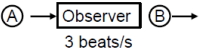
- 8Two sources of sound $S_1$ અને $S_2$ are moving towards and away from a stationary observer with the same speed respectively. Observer detects $3$ beats per second. Find speed of source (approximately). (in $m/s$)View Solution
Given, $F 1= F 2=500\, Hz$. speed of air $=330\, m / s$
- 9A tuning fork makes $256$ vibrations per second in air. When the velocity of sound is $330\, m/s$, then wavelength of the tone emitted is ... $m$View Solution
- 10A travelling wave represented by $y = A \sin (\omega t - kx )$ is susperimposed on another wave represented by $y = A$ $\sin (\omega t + kx )$. The resultant isView Solution