MCQ
A man standing on a road hold his umbrella at $30^° $ with the vertical to keep the rain away. He throws the umbrella and starts running at $10\, km/hr$. He finds that raindrops are hitting his head vertically, the speed of raindrops with respect to the road will be......... $km/hr$
  • A
    $10$
  • $20$
  • C
    $30$
  • D
    $40$

Answer

Correct option: B.
$20$
b
(b) When the man is at rest w.r.t. the ground, the rain comes to him at an angle $30^°$ with the vertical. This is the direction of the velocity of raindrops with respect to the ground.

Here ${\overrightarrow {v} _{rg}} = $ velocity of rain with respect to the ground

${\overrightarrow {v} _{mg}} = $ velocity of the man with respect to the ground.

and ${\overrightarrow {v} _{rm}} = $ velocity of the rain with respect to the man,

We have ${\overrightarrow {v} _{rg}} = {\overrightarrow {v} _{rm}} + {\overrightarrow {v} _{mg}}$......$(i)$

Taking horizontal components equation $ (i) $ gives

${v_{rg}}\sin \,30^\circ = {v_{mg}} = 10\,km/hr$
or ${v_{rg}} = \frac{{10}}{{\sin 30^\circ }} = 20\,km/hr$
Need a full question paper?

Generate a complete, print-ready paper with questions like this in minutes — across 16+ boards, with answer keys.

Start Generating Free

Similar questions

If two glass plates are quite nearer to each other in water, then there will be force of
Two non-reactive monoatomic ideal gases have their atomic masses in the ratio $2 : 3$. The ratio of their partial pressures, when enclosed in a vessel kept at a constant temperature, is $4 : 3$. The ratio of their densities is :-
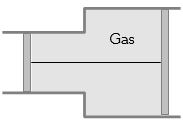
A gas is filled in the cylinder shown in the figure. The two pistons are joined by a string. If the gas is heated, the pistons will
A car is accelerated on a leveled road and attains a velocity $4$ times its initial velocity. In this process, the potential energy of the car:
A rocket is launched with velocity $10\, km/s$. If radius of earth is $R$, then maximum height attained by it will be
Four cylinders contain equal number of moles of argon, hydrogen, nitrogen and carbon dioxide at the same temperature. The energy is minimum in:
A transverse pulse generated at the bottom of a uniform rope of length $L$, travels in upward direction. The time taken by it to travel the full length of rope will be
From the following combinations of physical constants (expressed through their usual symbols) the only combination, that would have the same value in different systems of units, is
Two uniform solid spheres having unequal masses and unequal radii are released from rest from the same height on a rough incline. If the spheres roll without slipping:
Which of the following $($referred to a spherical mirror$)$ do $($does$)$ not depend on whether the rays are paraxial or not?