MCQ
A man waves his arms, while walking. This is:
  • A
    to balance the effect of earth's gravity
  • B
    to keep constant velocity
  • C
    to increase the velocity
  • D
    to ease the tension

Need a full question paper?

Generate a complete, print-ready paper with questions like this in minutes — across 16+ boards, with answer keys.
Start Generating Free

Similar questions

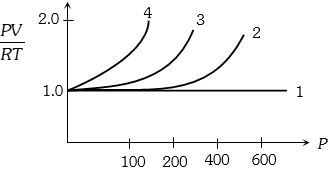
A fix amount of nitrogen gas ($1$ mole) is taken and is subjected to pressure and temperature variation. The experiment is performed at high pressure as well as high temperatures. The results obtained are shown in the figures. The correct variation of $PV/RT$ with $P$ will be exhibited by
The SI units of magnetic field is:
A body is projected from ground obliquely. During downward motion, power delivered by gravity to it
Two stones are projected with the same speed but making different angles with the horizontal. Their ranges are equal. If the angle of projection of one is $\pi /3$ and its maximum height is $h_1$ then the maximum height of the other will be
Which of the following statements are true for wave motion:
The fundamental frequency of a closed organ pipe is equal to the first overtone frequency of an open organ pipe. If length of the open pipe is $60 \mathrm{~cm}$, the length of the closed pipe will be :
The velocity at the maximum height of a projectile is $\frac{\sqrt{3}}{2}$ times its initial velocity of projection $(u)$. Its range on the horizontal plane is .............
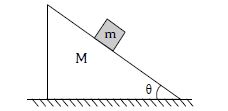
A block of mass $m$ slides down on a wedge of mass $M$ as shown in figure. Let $\vec a_1$ be the acceleration of the wedge and $\vec a_2$  the acceleration of block w.r.t. ground. $N_1$ is the normal reaction between block and wedge and $N_2$ the normal reaction between wedge and ground. Friction is absent everywhere. Select the incorrect alternative
If ${\mu _s},\,{\mu _k}$ and ${\mu _r}$ are coefficients of static friction, sliding friction and rolling friction, then
If two forces of $5 \,N$ each are acting along $X$ and $Y$ axes, then the magnitude and direction of resultant is