MCQ
A manometer connected to a closed tap reads $4.5 \times 10^5$ pascal. When the tap is opened the reading of the manometer falls to $4 \times 10^5$ pascal. Then the velocity of flow of water is
  • A
    $7 ms ^{-1}$
  • B
    $8 ms ^{-1}$
  • C
    $9 ms ^{-1}$
  • $10 ms ^{-1}$

Answer

Correct option: D.
$10 ms ^{-1}$
(d) $\frac{P_1-P_2}{\rho g}=\frac{v^2}{2 g} \Rightarrow \frac{4.5 \times 10^5-4 \times 10^5}{10^3 \times g}=\frac{v^2}{2 g} \therefore v=10 \mathrm{~m} / \mathrm{s}$

Need a full question paper?

Generate a complete, print-ready paper with questions like this in minutes — across 16+ boards, with answer keys.

Start Generating Free

Similar questions

An engine is supposed to operate between two reservoirs at temperature $727^{\circ} \mathrm{C}$ and $227^{\circ} \mathrm{C}$. The maximum possible efficiency of such an engine is
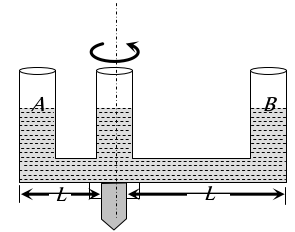
A given shaped glass tube having uniform cross section is filled with water and is mounted on a rotatable shaft as shown in figure. If the tube is rotated with a constant angular velocity $\omega$ then
Image
A wheel completes 2000 revolutions to cover the $9.5 km$. distance. then the diameter of the wheel is
The ratio of densities of nitrogen and oxygen is $14:16.$ The temperature at which the speed of sound in nitrogen will be same at that in oxygen at $55 {}^\circ\mathrm{C}$ is
A stone is thrown with an initial speed of $4.9 m / s$ from a bridge in vertically upward direction. It falls down in water after $2 sec$. The height of the bridge is
A microammeter has a resistance of $100 \Omega$ and full scale range of $50 \mu \mathrm{A}$. It can be used as a voltmeter or as a higher range ammeter provided a resistance is added to it. Pick the correct range and resistance combination
In an elliptical orbit under gravitational force, in general
The escape velocity of a particle of mass $m$ varies as
$M L^{-1} T^{-2}$ represents
The focal lengths of the objective and the eye-piece of a compound microscope are $2.0 \mathrm{~cm}$ and $3.0 \mathrm{~cm}$ respectively. The distance between the objective and the eye-piece is $15.0 \mathrm{~cm}$. The final image formed by the eye-piece is at infinity. The two lenses are thin. The distances in $\mathrm{cm}$ of the object and the image produced by the objective measured from the objective lens are respectively