Question
A manufacturer produces two products A and B. Both the products are processed on two different machines. The available capacity of first machine is 12 hours and that of second machine is 9 hours per day. Each unit of product A requires 3 hours on both machines and each unit of product B requires 2 hours on first machine and 1 hour on second machine. Each unit of product A is sold at Rs. 7 profit and that of B at a profit of Rs. 4. Find the production level per day for maximum profit graphically.
Answer

Let x units of product A and y units of product B be manufactured by the manufacturer per day.
It is given that one unit of product A requires 3 hours of processing time on first machine, while one unit of product B requires 2 hours of processing time on first machine.
It is also given that first machine is available for 12 hours per day.
$\therefore$ 3x + 2y ≤ 12
Also, one unit of product A requires 3 hours of processing time on second machine, while one unit of product B requires 1 hour of processing time on second machine.
It is also given that second machine is available for 9 hours per day.
$\therefore$ 3x + y ≤ 9
The profits on one unit each of product A and product B is Rs. 7 and Rs 4, respectively.
So, the objective function is given by Z =  Rs. (7x + 4y).
Therefore, the mathematical formulation of the given linear programming problem can be stated as:

Maximize Z = 7x + 4y 
Subject to the constraints
3x + 2y ≤ 12 .....(1)
3x + y ≤ 9 .....(2)
x ≥ 0, y ≥ 0 .....(3)
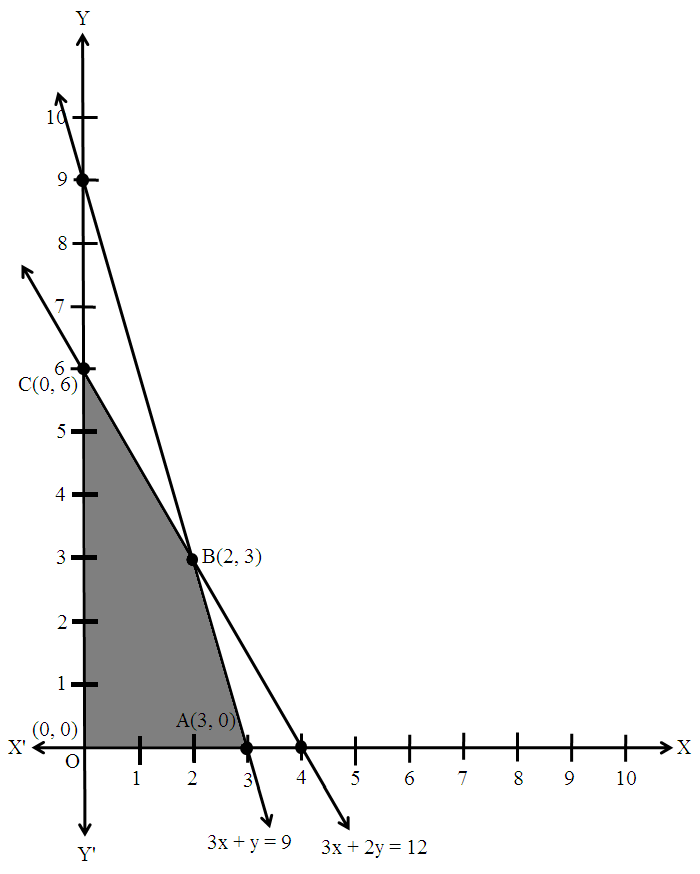
The feasible region determined by constraints (1) to (3) is graphically represented as:

Here, it is seen that OABCO is the feasible region and it is bounded.
The values of Z at the corner points of the feasible region are represented in tabular form as:
Corner point
Z = 7x + 4y
O(0, 0)
Z = 7 × 0 + 4 × 0 = 0
A(0, 10)
Z = 7 × 3 + 4 × 0 = 21
B(173, 0)
Z = 7 × 2 + 4 × 3 = 26
C(3, 8)
Z = 7 × 0 + 4 × 6 = 24
The maximum value of Z is 26, which is obtained at x = 2 and y = 3.
Thus, 2 units of product A and 3 units of product B should be manufactured by the manufacturer per day in order to maximize the profit.
Also, the maximum daily profit of the manufacturer is Rs. 26.

Need a full question paper?

Generate a complete, print-ready paper with questions like this in minutes — across 16+ boards, with answer keys.

Start Generating Free

Similar questions

If $\text{f}\text{(x)}=\begin{cases}\frac{\text{x}^2-1}{\text{x}-1},& \text{for }\text{ x}\neq1 \\2,&\text{for }\text{ x}=1\end{cases}$ Find whether f (x) is continuous at x = 1.
Verify Lagrange's mean value theorem for the following function on the indicated intervals. find a point 'c' in the indicated interval as stated by the Lagrange's mean value theorem.
f(x) = x(x - 1) on [1, 2]
Show that the function $\text{f(x)}=\begin{cases}|2\text{x}-3||\text{x}|, & \text{x}\geq1\\\sin\Big(\frac{\pi\text{x}}{2}\Big),& \text{x}>1\end{cases}$ is continuous but not differentiable at x = 1.
Find the equation of the line passing through the points (1, -1, 1) and perpendicular to the lines joining the points (4, 3, 2), (1, -1, 0) and (1, 2, -1) (2, 1, 1).
Prove that:
$\begin{vmatrix}\text{a}+\text{b}&\text{b}+\text{c}&\text{c}+\text{a}\\\text{b}+\text{c}&\text{c}+\text{a}&\text{a}+\text{b}\\\text{c}+\text{a}&\text{a}+\text{b}&\text{b}+\text{c}\end{vmatrix}=2\begin{vmatrix}\text{a}&\text{b}&\text{c}\\\text{b}&\text{c}&\text{a}\\\text{c}&\text{a}&\text{b} \end{vmatrix}$
Evaluate the following integrals:
$\int\limits_{0}^{{\pi}}\frac{1}{5+3\cos\text{x}}\text{ dx}$
Differentiate the following functions with respect to x:
$\tan^{-1}\Big(\frac{\text{a}+\text{bx}}{\text{b}-\text{ax}}\Big)$
If $\text{x}\sin(\text{a}+\text{y})+\sin\text{a}\cos(\text{a}+\text{y})=0,$ prove that $\frac{\text{dy}}{\text{dx}}=\frac{\sin^2(\text{a}+\text{y})}{\sin\text{a}}.$
A manufacturer makes two types of toys A and B. Three machines are needed for this purpose and the time (in minutes) required for each toy on the machines is given below:
Types of Toys Machines
I II III
A 12 18 6
B 6 0 9
Each machine is available for a maximum of 6 hours per day. If the profit on each toy of type A is Rs. 7.50 and that on each toy of type B is Rs. 5, show that 15 toys of type A and 30 of type B should be manufactured in a day to get maximum profit.
A class has 15 students whose ages are 14, 17, 15, 14, 21, 17, 19, 20, 16, 18, 20, 17, 16, 19 and 20 years. One student is selected in such a manner that each has the same chance of being chosen and the age X of the selected student is recorded. What is the probability distribution of the random variable X? Find mean, variance and standard deviation of X.