Question
A manufacturer produces two products A and B. Both the products are processed on two different machines. The available capacity of first machine is 12 hours and that of second machine is 9 hours per day. Each unit of product A requires 3 hours on both machines and each unit of product B requires 2 hours on first machine and 1 hour on second machine. Each unit of product A is sold at Rs. 7 profit and that of B at a profit of Rs. 4. Find the production level per day for maximum profit graphically.
Answer

Let x units of product A and y units of product B be manufactured by the manufacturer per day.
It is given that one unit of product A requires 3 hours of processing time on first machine, while one unit of product B requires 2 hours of processing time on first machine.
It is also given that first machine is available for 12 hours per day.
$\therefore$ 3x + 2y ≤ 12
Also, one unit of product A requires 3 hours of processing time on second machine, while one unit of product B requires 1 hour of processing time on second machine.
It is also given that second machine is available for 9 hours per day.
$\therefore$ 3x + y ≤ 9
The profits on one unit each of product A and product B is Rs. 7 and Rs 4, respectively.
So, the objective function is given by Z = Rs. (7x + 4y).
Therefore, the mathematical formulation of the given linear programming problem can be stated as:

Maximize Z = 7x + 4y
Subject to the constraints
3x + 2y ≤ 12 .....(1)
3x + y ≤ 9 .....(2)
x ≥ 0, y ≥ 0 .....(3)
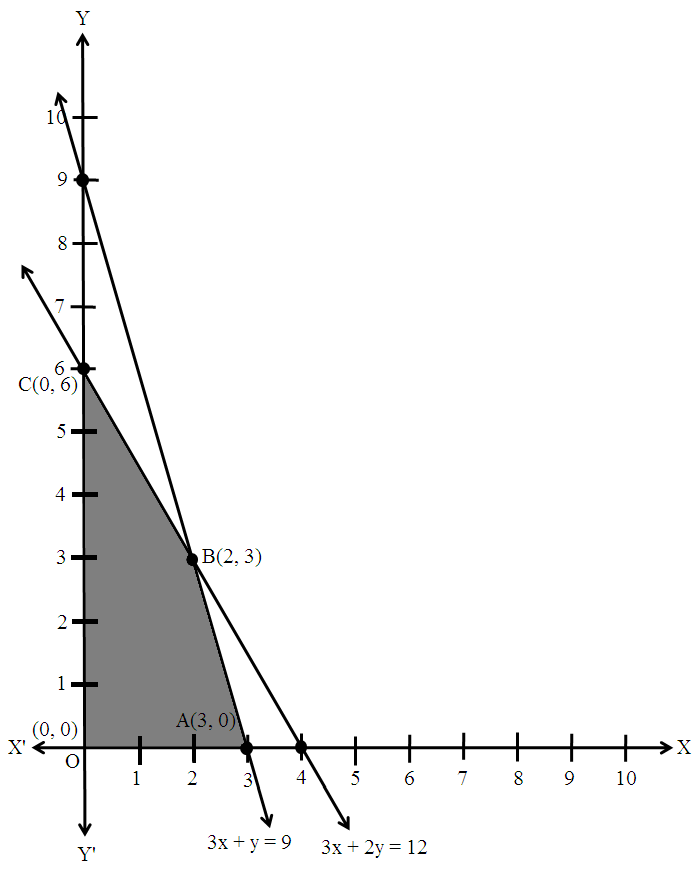
The feasible region determined by constraints (1) to (3) is graphically represented as:

Here, it is seen that OABCO is the feasible region and it is bounded.
The values of Z at the corner points of the feasible region are represented in tabular form as:
Corner point
Z = 7x + 4y
O(0, 0)
Z = 7 × 0 + 4 × 0 = 0
A(0, 10)
Z = 7 × 3 + 4 × 0 = 21
B(173, 0)
Z = 7 × 2 + 4 × 3 = 26
C(3, 8)
Z = 7 × 0 + 4 × 6 = 24
The maximum value of Z is 26, which is obtained at x = 2 and y = 3.
Thus, 2 units of product A and 3 units of product B should be manufactured by the manufacturer per day in order to maximize the profit.
Also, the maximum daily profit of the manufacturer is Rs. 26.

Need a full question paper?

Generate a complete, print-ready paper with questions like this in minutes — across 16+ boards, with answer keys.

Start Generating Free

Similar questions

Show that the vectors $\overrightarrow{\text{a}},\overrightarrow{\text{b}} \text{and}{\overrightarrow{\text{c}}}$ are coplanar if $\overrightarrow{\text{a}} +\overrightarrow{\text{b}}, \overrightarrow{\text{b}}+\overrightarrow{\text{c}}\text{and} \overrightarrow{\text{c}} + \overrightarrow{\text{a}}$ are coplanar.
Evaluate the following integrals:
$\int\limits^2_{-1}\big(|\text{x}+1|+|\text{x}|+|\text{x}-1|\big)\text{dx}$
If $\text{x}=\text{a}(\cos\theta+\theta\sin\theta),\text{y}=\text{a}(\sin\theta-\theta\cos\theta)$ prove that $\frac{\text{d}^2\text{x}}{\text{d}\theta^2}=\text{a}(\cos\theta-\theta\sin\theta),\frac{\text{d}^2}{\text{d}\theta^2}$ $=\text{a}(\sin\theta-\theta\cos\theta)\ \text{and}\ \frac{\text{d}^2\text{y}}{\text{dx}^2}=\frac{\sec^3\theta}{\text{a}\theta}$
Integrate the function $ \frac{{x + 2}}{{\sqrt {{x^2} + 2x + 3} }}$
Show that the function $\text{f(x)}\begin{cases}\text{x}^\text{m}\sin(\frac{1}{\text{x}}), &\text{x}\neq0 \\0 ,& \text{x}=0\end{cases}$
Neirher continuous but not diffierentiable, if $\text{m}\leq0$
If $\hat{\text{a}}$ and $\hat{\text{b}}$ are unit vectors inclined at an angle $\theta$, prove that$\tan\frac{\theta}{2}=\frac{\big|\hat{\text{a}}-\hat{\text{b}}\big|}{\big|\hat{\text{a}}+\hat{\text{b}}\big|}$
Differentiate $\sin^{-1}\Big(4\text{x}\sqrt{1-4\text{x}^2}\Big)$ with respect to $\sqrt{1-4\text{x}^2},$ if:
$\text{x}\in\Big(-\frac{1}{2},-\frac{1}{2\sqrt{2}}\Big)$
If $\text{A}=\begin{bmatrix}-2\\4\\5\end{bmatrix},\text{B}=\begin{bmatrix}1&3&-6\end{bmatrix},$ verify that $(AB)^T = B^TA^T$
For the matrices $A$ and $B$, verify that $(AB)^T = B^TA^T$, where $\text{A}=\begin{bmatrix}1&3\\2&4\end{bmatrix},\text{B}=\begin{bmatrix}1&4\\2&5\end{bmatrix}$
Find the Cartesian equation of the plane passing through the points A(0, 0, 0) and B(3, –1, 2) and parallel to the line $\frac{\text{x-4}}{1}=\frac{\text{y+3}}{-4}=\frac{\text{z+1}}{7}$ .