Question
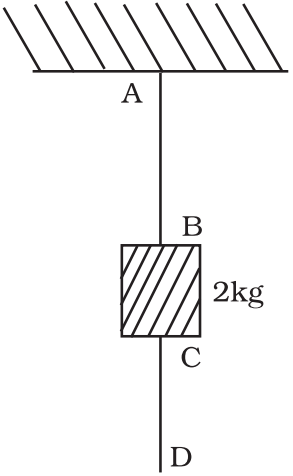
A mass of 2kg is suspended with thread AB Thread CD of the same type is attached to the other end of 2kg mass. Lower thread is pulled gradually, harder and harder in the downward directon so as to apply force on AB. Which of the threads will break and why?
Answer

Thread AB will break. Force on CD is equal to the force (f) applied at D downward, but the force on thread AB is equal to the force F along with force due to mass 2kg downward. so the force on AB is 2kg more than applied force at D.Hence the thread AB will break up.

Need a full question paper?

Generate a complete, print-ready paper with questions like this in minutes — across 16+ boards, with answer keys.

Start Generating Free

Similar questions

A tank used for filling helium balloons has a volume of $0.6 \mathrm{~m}^3$ and contains $2.0$ mol of helium gas at $20.0^{\circ} \mathrm{C}$. Assuming that the helium behaves like an ideal gas.
i. What is the total translational kinetic energy of the molecules of the gas?
ii. What is the average kinetic energy per molecule?
If water be used to construct a barometer, what would be the height of water column at standard atmospheric pressure (76cm of mercury)?
Find the average force needed to accelerate a car weighing 500kg from rest to 72km/h in a distance of 25m.
A car is lifted by a hydraulic jack that consist of two pistons. The large piston is 1m in diameter and small piston is 10cm in diameter. If W is the weight of the car, how much smaller a force is needed on the small piston to lift the car?
A particle is executing SHM according to the equation $\text{x}=5\sin\pi\text{t}$ where x is in cm. How long will the particle take to move from the position of equilibrium to the position of maximum displacement?
In an experiment, it was found that a tuning fork and a sonometer wire gave 5 beats per second, both when the length of the wire was 1m, and 1.05m. Calculate the frequency of the fork.
Two soap bubbles in vacuum having radii 3cm and 4cm respectively coalesce under isothermal conditions to form a single bubble. What is the radius of the new bubble?
The shells of crabs found around a particular coastal location in Japan seem mostly to resemble the legendary face of a Samurai. Given below are two explanations of this observed fact. Which of these strikes you as a scientific explanation?
  1. A tragic sea accident several centuries ago drowned a young Samurai. As a tribute to his bravery, nature through its inscrutable ways immortalised his face by imprinting it on the crab shells in that area.
  2. After the sea tragedy, fishermen in that area, in a gesture of honour to their dead hero, let free any crab shell caught by them which accidentally had a shape resembling the face of a Samurai. Consequently, the particular shape of the crab shell survived longer and therefore in course of time the shape was genetically propagated. This is an example of evolution by artificial selection.
[Note: This interesting illustration taken from Carl Sagan’s ‘The Cosmos’ highlights the fact that often strange and inexplicable facts which on the first sight appear ‘supernatural’ actually turn out to have simple scientific explanations. Try to think out other examples of this kind].
An object whose volume is $100 cm^3$ is completely immersed in water. Find the buoyant force on the object.
Which of the following functions of time represent (a) simple harmonic, (b) periodic but not simple harmonic, and (c) non-periodic motion? Give period for each case of periodic motion ($\omega$ is any positive constant): $\sin^3\omega\text{t}$