MCQ
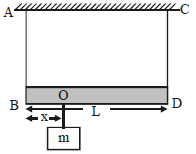
A massless rod of length $L$ is suspended by two identical strings $AB$ and $CD$ of equal length. A block of mass $m$ is suspended from point $O$ such that $BO$ is equal to $‘x’$. Further it is observed that the frequency of $1^{st}$ harmonic in $AB$ is equal to $2^{nd}$ harmonic frequency in $CD$. $‘x’$ is
  • $\frac{L}{5}$
  • B
    $\frac{4L}{5}$
  • C
    $\frac{3L}{4}$
  • D
    $\frac{L}{4}$

Answer

Correct option: A.
$\frac{L}{5}$
a
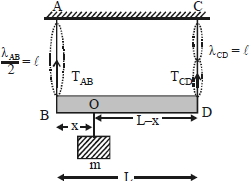
Frequency of $1$ st harmonic of $AB$

$=\frac{1}{2 \ell} \sqrt{\frac{\mathrm{T}_{\mathrm{AB}}}{\mathrm{m}}}$

Frequency of $2$ nd harmonic of $\mathrm{CD}$

$=\frac{1}{\ell} \sqrt{\frac{\mathrm{T}_{\mathrm{CD}}}{\mathrm{m}}}$

Given that the two frequencies are equal.

$\therefore \frac{1}{2 \ell} \sqrt{\frac{\mathrm{T}_{\mathrm{AB}}}{\mathrm{m}}}=\frac{1}{\ell} \sqrt{\frac{\mathrm{T}_{\mathrm{CD}}}{\mathrm{m}}}$

$\Rightarrow \frac{\mathrm{T}_{\mathrm{AB}}}{4}=\mathrm{T}_{\mathrm{CD}} \Rightarrow \mathrm{T}_{\mathrm{AB}}=4 \mathrm{T}_{\mathrm{CD}}$             $...(i)$

For rotational equilibrium of massless rod, taking torque about point $O.$

$\mathrm{T}_{\mathrm{AB}} \times \mathrm{x}=\mathrm{T}_{\mathrm{CD}}(\mathrm{L}-\mathrm{x})$             $...(ii)$

For translational equilibrium,

$\mathrm{T}_{\mathrm{AB}}+\mathrm{T}_{\mathrm{CD}}=\mathrm{mg}$       $..(iii)$

On solving, $(i)$ $\&(iii)$ we get, $\mathrm{T}_{\mathrm{CD}}-\frac{\mathrm{mg}}{5}$

$\therefore \mathrm{T}_{\mathrm{AB}}=\frac{4 \mathrm{mg}}{5}$

Substituting these values in $(ii)$ we get

$\frac{4 m g}{5} \times x=\frac{m g}{5}(L-x)$

$\Rightarrow 4 \mathrm{x}=\mathrm{L}-\mathrm{x} \Rightarrow \mathrm{x}=\frac{\mathrm{L}}{5}$
Need a full question paper?

Generate a complete, print-ready paper with questions like this in minutes — across 16+ boards, with answer keys.

Start Generating Free

Similar questions

Which of the following represents the dimensions of Farad
A particle is moved from $(0, 0)$  to $(a, a)$  under a force $F = (3\hat i + 4\hat j)$ from two paths. Path $1$ is $OP$ and path $2$  is $OQP$ . Let $W_1$ and $W_2$ be the work done by this force in these two paths respectively. Then
The velocity of kerosene oil in a horizontal pipe is $5 m/s.$  If $g = 10m/{s^2}$ then the velocity head of oil will be ....... $m$
In rotation of a rigid body about a fixed axis is that in which:
To what temperature should the hydrogen at $327°C$ be cooled at constant pressure, so that the root mean square velocity of its molecules become half of its previous value ....... $^oC$
Two gases have the same initial pressure, volume and temperatue. They expand to the same final volume, one adiabatically and the other isothermally, if the two gases are compressed to the same final volume
$Assertion :$ Two thin blankets put together are warmer than a single blanket of double the thickness.
$Reason :$ Thickness increases because of air layer enclosed between the two blankets.
A car is moving on a plane inclined at $30^{\circ}$ to the horizontal with an acceleration of $10\, {ms}^{-2}$ parallel to the plane upward. A bob is suspended by a string from the roof of the car.The angle in degrees which the string makes with the vertical is ...... . (Take ${g}=10\, {ms}^{-2}$ )
Water is flowing through a horizontal tube having cross-sectional areas of its two ends being $A$ and $A'$ such that the ratio $A/A'$ is $5$ છે.જો  If the pressure difference of water between the two ends is $3 \times 10^5\, N\, m^{-2}$, the velocity of water with which it enters the tube will be ......... $m s^{-1}$ (neglect gravity effects)
Three force $F_1=10\,N , F_2=8\,N , F _3=6\,N$ are acting on a particle of mass $5\,kg$. The forces $F _2$ and $F _3$ are applied perpendicular so that particle remains at rest. If the force $F_1$ is removed, then the acceleration of the particle is $......ms^{-2}$