Question
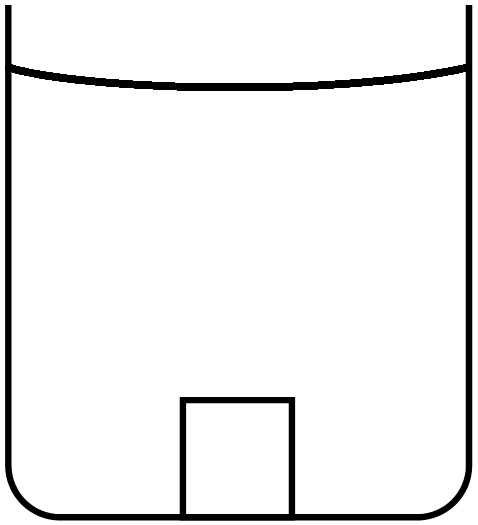
A metal piece of mass $160g$ lies in equilibrium inside a glass of water The piece touches the bottom of the glass at a small number of points. If the density of the metal is $8000kg/m^3$, find the normal force exerted by the bottom of the glass on the metal piece.
Answer

Given mass of the metal piece, $m = 160g = 0.160kg$
Density of metal = $8000kg/m^3$
Here we can say that the weight of the metal piece = buoyant force(FB) + Normal force
i.e. weight of the metal piece = mg
$\text { Buoyant force, } F_B=\text { Volume of water displaced by metal } \times P_{\text {water }} \times g$
$m g=F B+\text { Normal force }$
$\text { Normal force }=m g-F_B$
$=m \times g-V \times P_{\text {water }} \times g$
Volume of water displaced by metal. = $=\frac{\text{m}}{\text{pwater}}=\frac{0.160}{8000}=0.00002$
Normal force = (0.160 × 9.8) - (0.00002 × 1000 × 9.8)
= 1.568 - 0.196
= 1.372N
= 1.4N

Need a full question paper?

Generate a complete, print-ready paper with questions like this in minutes — across 16+ boards, with answer keys.

Start Generating Free

Similar questions

A block moves with uniform circular motion because a cord tied to the block is anchored at the centre of a circle. Is the power of the force exerted on the block by the cord positive, negative or zero?
Suppose the tube in the previous problem is kept vertical with A upward but the other conditions remain the same. The separation between the cross$-$ sections at $A$ and $B$ is $\frac{15}{16}\text{cm}.$ Repeat parts $(a), (b$) and $(c)$ of the previous problem. Take $g = 10m/s^2$.
Find the scalar product of two vectors $\vec{\text{a}}=(3\hat{\text{i}}-4\hat{\text{j}}+5\hat{\text{k}})$ and $\vec{\text{b}}=(-2\hat{\text{i}}+\hat{\text{j}}-3\hat{\text{k}}).$
Give the magnitude and direction of the net force acting on a stone of mass 0.1kg, (Neglect air resistance throughout.) Just after it is dropped from the window of a stationary train.
The contact angle between water and glass is $0^º$. When water is poured in a glass to the maximum of its capacity, the water surface is convex upward. The angle of contact in such a situation is more than $90^º$. Explain.
How is the value of spring constant affected when several small indentical spring are combined (i) in series and (ii) in parallel?
If a drop of water falls on a very hot iron, it does not evaporate for a long time, why?
When blown between two light balls hanging near each other, they are attracted towards each other why?
Give the location of the centre of mass of a:
  1. Sphere.
  2. Cylinder.
  3. Ring, and
  4. Cube, each of uniform mass density.
Does the centre of mass of a body necessarily lie inside the body?
A conducting circular loop of radius a is connected to two Iong, straight wires. The straight wires carry current I as shown in figure. Find the magnetic field B at the centre of the loop.