Question
A metallic loop is placed in a nonuniform magnetic field. Will an emf be induced in the loop?

Answer

As the magnetic field is non uniform thus it will induce only small electric field in different directions so there would be no net current in the loop.

Need a full question paper?

Generate a complete, print-ready paper with questions like this in minutes — across 16+ boards, with answer keys.
Start Generating Free

Similar questions

Two point charges $5 \mu C$ and $-5 \mu C$ are kept at a distance of 1 cm from each other. Calculate the intensity of the electric field at a distance of 0.30 cm from mid-point (i) in the axial position, (ii) in neutral position.
If a mosquito is dipped into water and released, it is not able to fly till it is dry again. Explain.
A steel blade placed gently on the surface of water floats on it. If the same blade is kept well inside the water, it sinks. Explain.
Calculate $\frac{\text{n(T)}}{\text{n}(1000\text{K})}$ for tungsten emitter at T = 300K, 2000K and 3000K, where n(T) represents the number of thermions emitted per second by the surface at temperature T. Work function of tungsten is 4.52eV.
The needle of a dip circle shows an apparent dip of 45° in a particular position and 53° when the circle is rotated through 90°. Find the true dip.
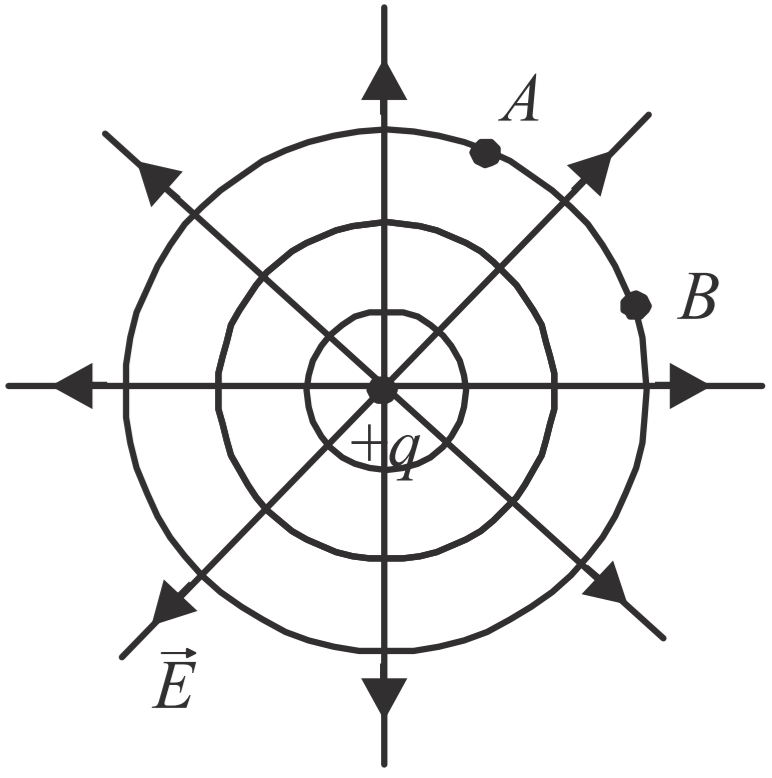
For the various charge systems, we represent equipotential surfaces by curves and line of force by full line curves. Between any two adjacent equipotential surfaces, we assume a constant potential difference the equipotential surfaces of a single point charge are concentric spherical shells with their centres at the point charge. As the tines of force point radially outwards, so they are perpendicular to the equipotential surfaces at all points.
  1. Identify the wrong statement.
  1. Equipotential surface due to a single point charge is spherical.
  2. Equipotential surface can be constructed for dipoles too.
  3. The electric field is normal to the equipotential surface through the point.
  4. The work done to move a test charge on the equipotential surface is positive.
  1. Nature of equipotential surface for a point charge is:
  1. Ellipsoid with charge at foci.
  2. Sphere with charge at the centre of the sphere.
  3. Sphere with charge on the surface of the sphere.
  4. Plane with charge on the surface.
  1. A spherical equipotential surface is not possible:
  1. Inside a uniformly charged sphere.
  2. For a dipole.
  3. Inside a spherical condenser.
  4. For a point charge.
  1. The work done in carrying a charge q once round a circle of radius a with a charge Q at its centre is:
  1. $\frac{\text{qQ}}{4\pi\in_0\text{a}}$
  2. $\frac{\text{qQ}}{4\pi\in_0\text{a}^2}$
  3. $\frac{\text{q}}{4\pi\in_0\text{a}}$
  4. $\text{Zero}$
  1. The work done to move a unit charge along an equipotential surface from P to Q:
  1. Must be defined as $-\int\limits_{\text{P}}^{\text{Q}}\vec{\text{E}}\cdot\text{d}\vec{\text{l}}.$
  2. Is zero.
  3. Can have a non-zero value.
  4. Both (a) and (b) are correct.
A magnetic needle is free to rotate in a vertical plane which makes an angle of 60° with the magnetic meridian. If the needle stays in a direction making an angle of $\tan^{-1}\Big(\frac{2}{\sqrt{3}}\Big)$ with the horizontal, what would be the dip at that place?
Suppose the density of air at Madras is $P_0$ and atomospheric pressure is $P_0$. If we go up, the density and the pressure both decrease. Suppose we wish to calculate the pressure at a height 10km above Madras. If we use the equation $P_0- P =$ pogz, will we get a pressure more than the actual or less than the actual? Neglect the variation in g. Does your answer change if you also consider the variation in g?
When white radiation is passed through a sample of hydrogen gas at room temperature, absorption lines are observed in Lyman series only. Explain.
Currents can be induced not only in conducting coils, but also in conducting sheets or blocks. Current is induced in solid metallic masses when the magnetic flux threading through them changes. Such currents flow in the from of irregularly shaped loops throughout the body of the metal. These currents look like eddies or whirlpools in water so they are known as eddy currents. Eddy currents have both undesirable effects and practically useful applications. For example it causes unnecessary heating and wastage of power in electric motors, dynamos and in the cores of transformers.
  1. The working of speedometers of trains is based on:
  1. Wattless currents.
  2. Eddy currents.
  3. alternating currents.
  4. pulsating currents.
  1. Identify the wrong statement.
  1. Eddy currents are produced in a steady magnetic field.
  2. Induction furnace uses eddy currents to produce heat.
  3. Eddy currents can be used to produce braking force in moving trains.
  4. Power meters work on the principle of eddy currents.
  1. Which of the following is the best method to reduce eddy currents?
  1. Laminating core.
  2. Using thick wires.
  3. By reducing hysteresis loss.
  4. None of these.
  1. The direction of eddy currents is given by:
  1. Fleming's left hand rule.
  2. Biot-Savart law.
  3. Lenz's law
  4. Ampere-circuital law.
  1. Eddy currents can be used to heat localised tissues of the human body. This branch of medical therapy is called:
  1. Hyperthermia.
  2. Diathermy.
  3. Inductothermy.
  4. None of these.