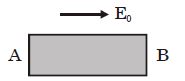
A metallic rod is placed in a uniform electric field. Select the correct option.
Easy
Download our app for free and get started
Download our app
and get started for free
Experience the future of education. Simply download our apps or reach out to us for more information. Let's shape the future of learning together!No signup needed.*
Two charges $ + 3.2 \times {10^{ - 19}}\,C$ and $ - 3.2 \times {10^{ - 19}}\,C$ kept $2.4\, \mathop A\limits^o $ apart forms a dipole. If it is kept in uniform electric field of intensity $4 \times {10^5}\,volt/m$ then what will be its electrical energy in equilibrium
The maximum electric field that can be held in air without producing ionisation of air is $10^7\,V/m$. The maximum potential therefore, to which a conducting sphere of radius $0.10\,m$ can be charged in air is
A metal ball of radius $R$ is placed concentrically inside a hollow metal sphere of inner radius $2R $ and outer radius $3R$. The ball is given a charge $+2Q$ and the hollow sphere a total charge $- Q$. The electrostatic potential energy of this system is :
A resistor '$R$' and $2\ μF$ capacitor in series is connected through a switch to $200\ V$ direct supply. Across the capacitor is a neon bulb that lights up at $120\ V$. Calculate the value of $R$ to make the bulb light up $5\ s$ after the switch has been closed. $(log_{10} 2.5 = 0.4)$.
Two capacitors $A$ and $B$ are connected in series with a battery as shown in the figure. When the switch $S$ is closed and the two capacitors get charged fully, then
Two identical capacitors $1$ and $2$ are connected in series. The capacitor $2$ contains a dielectric slab of constant $K$ as shown. They are connected to a battery of emf $V_0\ volts$ . The dielectric slab is then removed. Let $Q_1$ and $Q_2$ be the charge stored in the capacitors before removing the slab and $Q'_1$ , and $Q'_2$ be the values after removing the slab. Then
A charged particle $q$ is shot towards another charged particle $Q$ which is fixed, with a speed $v$. It approaches $Q$ upto a closest distance $r$ and then returns. If $q$ were given a speed $2v$, the closest distances of approach would be