MCQ
A $metre$ scale is suspended vertically from a horizontal axis passing through one end of it. Its time period would be ....... $\sec$
  • $1.64$
  • B
    $2$
  • C
    $2.5$
  • D
    $3.2$

Answer

Correct option: A.
$1.64$
a

Need a full question paper?

Generate a complete, print-ready paper with questions like this in minutes — across 16+ boards, with answer keys.
Start Generating Free

Similar questions

Motion of a ball bearing inside a smooth curved bowl, when released from a point slightly above the lower point is:
Which of the following statements is true regarding the molecular kinetic theory of gases?
If the ratio of specific heat of a gas at constant pressure to that at constant volume is $\gamma $, the change in internal energy of a mass of gas, when the volume changes from $V$ to $2V$ constant pressure $ p$, is
When a body is spinning on its axis in absence of any external torque, then choose the wrong statement
Equations ${y_1} = A\sin \omega t$ and ${y_2} = \frac{A}{2}\sin \omega t + \frac{A}{2}\cos \omega t$ represent $S.H.M.$ The ratio of the amplitudes of the two motions is
A block of mass m is placed on a smooth inclined plane of inclination $\theta$ with the horizontal. The force exerted by the plane on the block has a magnitude:
A vehicle is moving with speed $v$ on a curved road of radius $r$. The coefficient of friction between the vehicle and the road is $\mu$. The angle $\theta$ of banking needed is given by
The force constants of two springs are ${K_1}$ and ${K_2}$. Both are stretched till their elastic energies are equal. If the stretching forces are ${F_1}$ and ${F_2}$, then ${F_1}:{F_2}$ is
The upper half of an inclined plane of inclination $\theta$ is perfectly smooth while the lower half is rough. A body starting from the rest at top comes back to rest at the bottom if the coefficient of friction for the lower half is given by
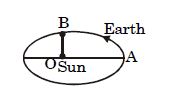
The earth moves around the Sun in an elliptical orbit as shown in figure.The ratio $OA/OB = x$ . The ratio of the speed of the earth at $B$ to that at $A$ is nearly