Question
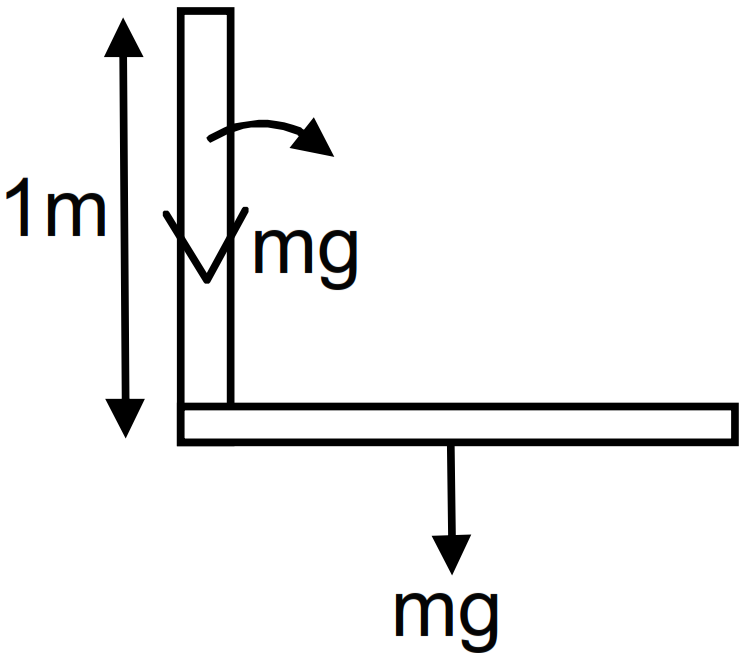
A metre stick is held vertically with one end on a rough horizontal floor. It is gently allowed to fall on the floor. Assuming that the end at the floor does not slip, find the angular speed of the rod when it hits the floor.
Answer

Let the mass of the rod = m Therefore applying laws of conservation of energy$\frac{1}{2}\text{l}\omega^2=\text{mg}\frac{\text{l}}2{}$
$\Rightarrow\frac{1}{2}\times\text{M}\frac{\text{l}^2}{3}\times\omega^2=\text{mg}\frac{1}{2}$
$\Rightarrow\omega^2=\frac{\text{3g}}{\text{l}}$
$\Rightarrow\omega=\sqrt{\frac{\text{3g}}{\text{l}}}=5.42\text{rad/s.}$

Need a full question paper?

Generate a complete, print-ready paper with questions like this in minutes — across 16+ boards, with answer keys.
Start Generating Free

Similar questions

Deduce by the method of dimensions, an expression for the energy of a body executing S.H.M. assuming that the energy of the body depends upon (a) the mass m (b) the frequency v and (c) the amplitude of vibration a.
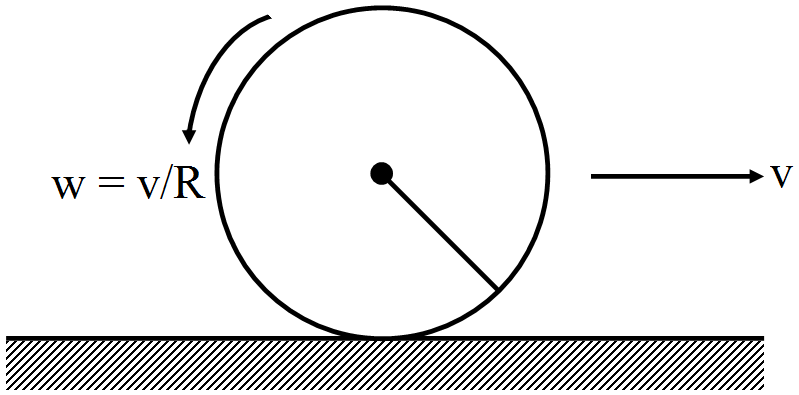
A solid sphere is set into motion on a rough horizontal surface with a linear speed $v$ in the forward direction and an angular speed $\frac{\text{v}}{\text{R}}$ in the anticlockwise direction as shown in figure. Find the linear speed of the sphere:
  1. When it stops rotating.
  2. When slipping finally ceases and pure rolling starts.
Prove that the rate of change of the angular momentum of particle is equal to the torque acting on it.
The distance x travelled by a body in a straight line is directly proportional to $t^2$. Decide on the type of motion associated. If $\text{x}\propto\text{t}^3$ what change will you observe?
Give the essential feature of kinetic theory of gases. Show that the pressure exerted by a gas is equal to two$-$third of the average kinetic energy.
A particle moves in a circle of diameter 1.0cm under the action of a magnetic field of 0.40T. An electric field of $200 Vm^{-1}$ makes the path straight. Find the charge/ mass ratio of the particle.
Two bodies A and B have thermal emissivity of 0.01 and 0.81 respectively. The outer surface area as of both the bodies are same. The two emit the same total radiated power. The wavelength $\lambda_\text{B}$ corresponding to the maximum intensity in radiations from B, is shifted from the wavelength $\lambda_\text{A}$ a corresponding to the maximum intensity in radiations from A by $1\mu\text{m}.$ If the temperature of body A is 5802K, find the temperature of body B and the wavelength ago $\lambda_\text{B}.$
Calculate the Q-value of the fusion reaction
${ }^4 \mathrm{He}+{ }^4 \mathrm{He}={ }^8 \mathrm{Be} .$
A rope of negligible mass is wound round a hollow cylinder of mass $3kg$ and radius $40cm$. What is the angular acceleration of the cylinder if the rope is pulled with a force of $30N$? What is the linear acceleration of the rope? Assume that there is no slipping.
Visible light has wavelengths in the range of 400nm to 780nm. Calculate the range of energy of the photons of visible light.