Question
A micron is related to centimetre as

Answer

(d) $1\,\,micron = {10^{ - 6}}m = {10^{ - 4}}cm$

Need a full question paper?

Generate a complete, print-ready paper with questions like this in minutes — across 16+ boards, with answer keys.

Start Generating Free

Similar questions

For an equilateral prism, it is observed that when a ray strikes grazingly at one face it emerges grazingly at the other. Its refractive index will be
A block of rectangular size of mass $m$ and area of cross-section $A$, floats in a liquid of density $\rho$. If we give a small vertical displacement from equilibrium, it undergoes $S H M$ with time period $T$, then
In a conductor $4$ coulombs of charge flows for $2$ seconds. The value of electric current will be
The number density of molecules of a gas depends on their distance $r$ from the origin as, $n\left( r \right) = {n_0}{e^{ - \alpha {r^4}}}$. Then the total number of molecules is proportional to
An electron with kinetic energy $5 \mathrm{eV}$ enters a region of uniform magnetic field of $3 \mu \mathrm{T}$ perpendicular to its direction. An electric field $\mathrm{E}$ is applied perpendicular to the direction of velocity and magnetic field. The value of $\mathrm{E}$, so that electron moves along the same path, is . . . . . $\mathrm{NC}^{-1}$.

(Given, mass of electron $=9 \times 10^{-31} \mathrm{~kg}$, electric charge $=1.6 \times 10^{-19} \mathrm{C}$ )
A gas has volume $V$ and pressure $P$. The total translational kinetic energy of all the molecules of the gas is
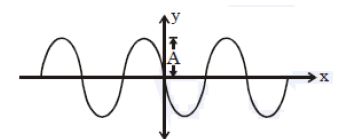
A progressive wave travelling along the positive $x-$ direction is represented by $y(x, t) = A\,sin\,\left( {kx - \omega t + \phi } \right)$. Its snapshot at $t = 0$ is given in the figure For this wave, the phase $\phi $ is
Two men, of masses $60\, kg$ and $80\, kg$ are sitting at the ends of $a$ boat of mass $60\, kg$ and length $4\, m$. The boat is stationary. If the men now exchange their positions, then
Which of the following show keto-enol isomerism
An electric charge ${10^{ - 3}}\,\mu \,C$ is placed at the origin $(0, 0)$ of $X -Y$ co-ordinate system. Two points $A$ and $B$ are situated at $\left( {\sqrt {2\,} \,,\,\,\sqrt 2 } \right)$  and $(2, 0)$ respectively. The potential difference between the points $A$ and $B$ will be......$volt$