Question
$A$ microscope is focused on a point object and then its objective is raised through a height of $2cm$. If a glass slab of refractive index $1.5$ is placed over this point object such that it is focused again, the thickness of the glass slab is......$cm$
Answer

$6$

Need a full question paper?

Generate a complete, print-ready paper with questions like this in minutes — across 16+ boards, with answer keys.

Start Generating Free

Similar questions

Bottom of a lake is at $0^{\circ} C$ and atmospheric temperature is $-20^{\circ} C$. If $1 cm$ ice is formed on the surface in $24 \,h$, then time taken to form next $1 \,cm$ of ice is ......... $h$
Ten $60 \,W , 220 \,V$ bulbs are connected in series to $220 \,V$ supply. Power consumed in the circuit is ......... $W$
The latent heat of vaporization of water is $2240 \,J/gm$. If the work done in the process of vaporization of $1\, gm$ is $168\, J$, then increase in internal energy is  .... $J$
An electron starting from rest has a velocity that increases linearly with the time that is $v = kt,$ where $k = 2m/{\sec ^2}$. The distance travelled in the first $3 \,seconds$ will be...........$m$
An object is projected upwards with a velocity of $100 \,m/s$. It will strike the ground after (approximately)........$sec$
The coefficient of linear expansion of a crystalline substance in one direction is $2 \times 10^{-4} /{ }^{\circ} C$ and in every direction perpendicular to it is $3 \times 10^{-4} /{ }^{\circ} C$. The coefficient of cubical expansion of crystal is equal to ........... $\times 10^{-4} /{ }^{\circ} C$
A particle is doing simple harmonic motion of amplitude $0.06 \mathrm{~m}$ and time period $3.14 \mathrm{~s}$. The maximum velocity of the particle is. . . . .. . $\mathrm{cm} / \mathrm{s}$.
To find the distance $d$ over which a signal can be seen clearly in foggy conditions, a railways engineer uses dimensional analysis and assumes that the distance depends on the mass density $\rho$ of the fog, intensity (power/area) $S$ of the light from the signal and its frequency $f$. The engineer find that $d$ is proportional to $S ^{1 / n}$. The value of $n$ is:
A horse rider covers half the distance with $5\,m / s$ speed. The remaining part of the distance was travelled with speed $10\,m / s$ for half the time and with speed $15 m / s$ for other half of the time. The mean speed of the rider averaged over the whole time of motion is $\frac{x}{7}\,m / s$. The value of $x$ is
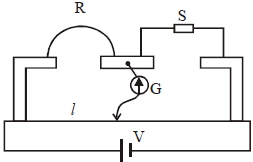
In a meter bridge experiment $\mathrm{S}$ is a standard resistance. $\mathrm{R}$ is a resistance wire. It is found that balancing length is $l=25 \;\mathrm{cm} .$ If $\mathrm{R}$ is replaced by a wire of half length and half diameter that of $\mathrm{R}$ of same material, then the balancing distance $\left.l^{\prime} \text { (in } \mathrm{cm}\right)$ will now be