MCQ
A missile is fired for maximum range at your town from a place $100\, km$ away from you. If the missile is first detected at its half way point, how much warning time will you have ? (Take $g = 10\, m/s^2$) what was the speed of missile when it was detected ?
  • A
    $100\, m/s$
  • B
    $500\, m/s$
  • $500\sqrt 2 \,s$
  • D
    $100\sqrt 2 \,s$

Answer

Correct option: C.
$500\sqrt 2 \,s$
c
$u \cos \theta=\sqrt{g R} \times \frac{1}{\sqrt{2}}$

$=\sqrt{10 \times 10^{5}} \times \frac{1}{\sqrt{2}}=\frac{1000}{\sqrt{2}}$

$=\frac{500 \times 2}{\sqrt{2}}=500 \sqrt{2} \mathrm{m} / \mathrm{s}$

Need a full question paper?

Generate a complete, print-ready paper with questions like this in minutes — across 16+ boards, with answer keys.

Start Generating Free

Similar questions

Two bodies $A$ and $B$ of mass $m$ and $2\, m$ respectively are placed on a smooth floor. They are connected by a spring of negligible mass. $A$ third body $C$ of mass $m$ is placed on the floor. The body $C$ moves with a velocity $v_0$ along the line joining $A$ and $B$ and collides elastically with $A$. At a certain time after the collision it is found that the instantaneous velocities of $A$ and $B$ are same and the compression of the spring is $x_0$. The spring constant $k$ will be
Statement$-1:$ Two longitudinal waves given by equations $y _{1}( x , t )=2 a \sin (\omega t - kx )$ and $y _{2}( x , t )= a \sin (2 \omega t -2 kx )$ will have equal intensity.

Statement$-2:$ Intensity of waves of given frequency in same medium is proportional to square of amplitude only.

A mass $m$ attached to a spring oscillates with a period of $3\,s$. If the mass is increased by $1\,kg$ the period increases by $1\,s$. The initial mass $m$ is
Two bodies of masses m and $2m$ have same momentum. Their respective kinetic energies ${E_1}$ and ${E_2}$ are in the ratio
The relative uncertainty in the period of a sateilite orbiting around the earth is $10^{-2}$. If the relative uncertainty in the radius of the orbit is negligible, the relative uncertainty in the mass of the earth is
A copper wire of length $4.0m$ and area of cross-section $1.2\,c{m^2}$ is stretched with a force of $4.8 \times {10^3}$ $N.$ If Young’s modulus for copper is $1.2 \times {10^{11}}\,N/{m^2},$ the increase in the length of the wire will be
A small block slides without friction down an inclined plane starting from rest. Let ${S_n}$be the distance travelled from time $t = n - 1$ to $t = n.$ Then $\frac{{{S_n}}}{{{S_{n + 1}}}}$ is
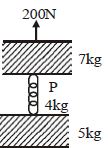
Two blocks of  $7\,\,kg$ and $5\,\,kg$  are connected by a heavy rope of mass $4\,\,kg.$ An upward force of $200\,N$  is applied as shown in the diagram. The tension at the top of heavy rope at point $P$  is ....... $N$ $(g = 10\,\,m/s^2)$
A completely inelastic collision is one in which the two colliding particles
Which relation is correct for isometric process