Question
A molecule in a gas container hits a horizontal wall with speed $200 ms^{-1}$ and angle $30^{\circ}$ with the normal, and rebounds with the same speed. Is momentum conserved in the collision? Is the collision elastic or inelastic?
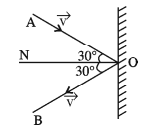
Answer

Momentum is always conserved in all collisions, hence momentum will be conserved in the given situations
also. Therefore, the molecular speed is the same before and after the collision, hence the kinetic energy will also be conserved. Thus this collison is elastic. If the mass of gas molecule is m and mass of wall is M then total kinetic energy after elasticity is
$\begin{array}{l} E _2=\frac{1}{2} m(200)^2+\frac{1}{2} M \times(0)^2 \\ E _2=2 \times 10^4 m J\end{array}$
 Image
Kinetic energy of the molecule before the collison,
$
\begin{array}{l}
E_1=\frac{1}{2} m(200)^2=2 \times 10^4 m J \\
E_1=E_2
\end{array}
$
Hence, the collision is elastic.

Need a full question paper?

Generate a complete, print-ready paper with questions like this in minutes — across 16+ boards, with answer keys.
Start Generating Free

Similar questions

Calculate focal length of a spherical mirror from the following observations: object distance $\text{u} = (50.1 \pm 0.5)\text{cm}$ and image distance $\text{v} = (20.1 \pm0.2)\text{cm} .$
A travelling harmonic wave on a string is described by
$\text{y}(\text{x, t})=7.5\sin\Big(0.0050\text{x}+12\text{t}+\frac{\pi}{4}\Big)$
Locate the points of the string which have the same transverse displacements and velocity as the x = 1cm point at t = 2s, 5s and 11s.
The electric field in a region is given by $\overrightarrow{\text{E}}=\frac{3}{5}\text{E}_0\overrightarrow{\text{i}}+\frac{4}{5}\text{E}_0\overrightarrow{\text{j}}$ with $\text{E}_0=2.0\times10^3\text{NC}^{-1}.$ Find the flux of this field through a rectangular surface of area 0.2m2 parallel to the y-z plane.
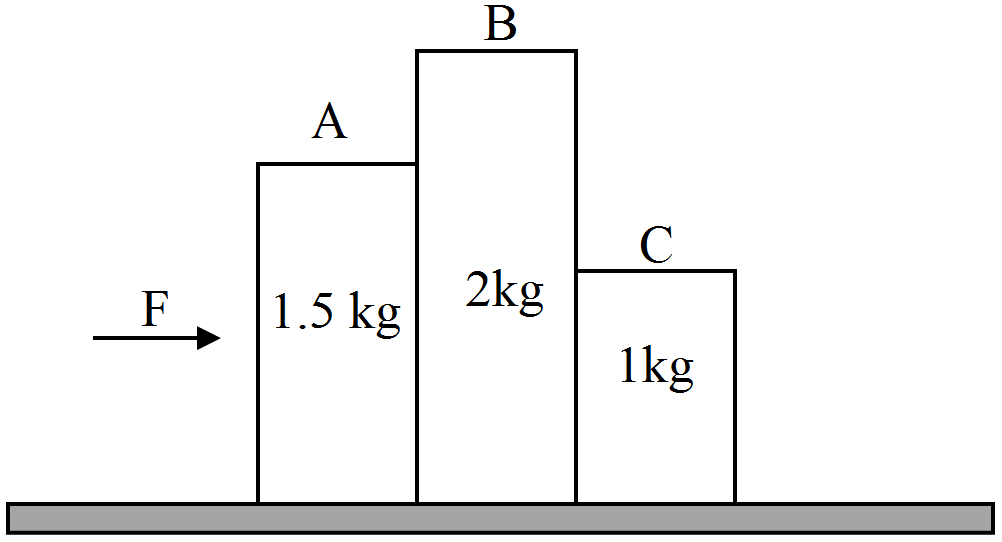
In the system of three blocks A, B and C shown in figure, (i) how large a force F is needed to give the blocks an acceleration of 3m/s2, if the coefficient of friction between blocks and table is 0.27 (ii) how large a force does the block A exert on the block B?

A body starts accelerating uniformly with a from a velocity ‘u' and travels in a straight line. Prove that it covers a length of $\text{u}+\frac{\text{a}}{2}(2\text{t}-1)$ in the tth second of motion.
Can two particles be in equilibrium under the action of their mutual gravitational force? Can three particles be? Can one of the three particles be?
Prove that the path of a projectile is a parabola.
Reynold's number NR(a dimensionless quantity) determines the condition of laminar flow of a viscous liquid through a pipe. NR is a function of the density of the liquid 'r', its average speed is 'y' and the coefficient of viscosity of the liquid is 'h'. If N, is given directly proportional to 'd' (the diameter of the pipe), show from dimensional consideration that $\text{N}_\text{R}\propto \frac{\text{dp}\rho}{\eta}$ the unit of '$\eta$' in SI system is kg m-1s-1?
Show that the coefficient of area expansion, $(\triangle A / A) / \Delta T$, of a rectangular sheet of the solid is twice its linear expansivity, $\alpha_1$.
A steel cable with a radius of 1.5 cm supports a chairlift at a ski area. If the maximum stress is not to exceed $10^8 Nm ^{-2}$, what is the maximum load the cable can support?