MCQ
A molecule in a gas container hits a horizontal wall with speed 200ms-2 and angle 30° with the normal and rebounds with the same speed. Which statement is true?
  • A
    Momentum is conserved.
  • B
    Elastic collision.
  • C
    Inelastic collision.
  • D
    Both (a) and (b).

Answer

  1. Both (a) and (b).

Need a full question paper?

Generate a complete, print-ready paper with questions like this in minutes — across 16+ boards, with answer keys.

Start Generating Free

Similar questions

An airplane must reach a take of speed of 80m/ s in a 1000m long runway. What minimum constant acceleration is required? (in m/ s2):
A gas is filled in a cylinder, its temperature is increased by $20\%$ on kelvin scale and volume is reduced by $10\%$ . How much percentage of the gas will leak out at constant pressure  ...... $\%$
A black hole is an object whose gravitational field is so strong that even light cannot escape from it. To what approximate radius would earth $($ mass $= 5 .98 \times \,10^{24}\, kg)$ have to be compressed to be a black hole?
Taking the gravitational potential at a point infinte distance away as zero, the gravitational potential at a point $A$ is $-5\, unit$. If the gravitational potential at point infinite distance away is taken as $+ 10\, units$, the potential at point $A$ is ......... $unit$
Two Carnot engines $A$ and $B$ are operated in succession. The first one, $A$ receives heat from a source at ${T_1} = 800K$ and rejects to sink at ${T_2}K.$. The second engine $B$ receives heat rejected by the first engine and rejects to another sink at ${T_3} = 300K.$ If the work outputs of two engines are equal, then the value of ${T_2}$ is .... $K$
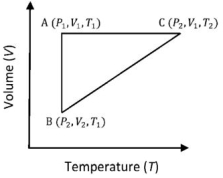
A reversible cyclic process for an ideal gas is shown below. Here, $P, V$, and $T$ are pressure, volume and temperature, respectively. The thermodynamic parameters $q, w, H$ and $U$ are heat, work, enthalpy and internal energy, respectively.

(image)

The correct option ($s$) is (are)

$(A)$ $q_{A C}=\Delta U_{B C}$ and $W_{A B}=P_2\left(V_2-V_1\right)$

$(B)$ $\mathrm{W}_{\mathrm{BC}}=\mathrm{P}_2\left(\mathrm{~V}_2-\mathrm{V}_1\right)$ and $\mathrm{q}_{\mathrm{BC}}=\mathrm{H}_{\mathrm{AC}}$

$(C)$ $\Delta \mathrm{H}_{\mathrm{CA}}<\Delta \mathrm{U}_{\mathrm{CA}}$ and $\mathrm{q}_{\mathrm{AC}}=\Delta \mathrm{U}_{\mathrm{BC}}$

$(D)$ $\mathrm{q}_{\mathrm{BC}}=\Delta \mathrm{H}_{\mathrm{AC}}$ and $\Delta \mathrm{H}_{\mathrm{CA}}>\Delta \mathrm{U}_{\mathrm{CA}}$

$\vec{A}$ is a vector of magnitude $2.7$ units due east. What is the magnitude and direction of vector $4 \vec{A}$ ?
A projectile is given an initial velocity of $(\hat i + 2\hat j)\ ms^{-1}$, where $\hat i$ is along the ground and $\hat j$ is along the vertical. If $g = 10\ m/s^2$ , the equation of its trajectory is
A big drop is formed by coalescing $1000$ small droplets of water. The surface energy will become :
The ratio of escape velocity at earth $\left( v _{ e }\right)$ to the escape velocity at a planet $\left( u _{ p }\right)$ whose radius and mean density are twice as that of earth is: