Question
A molecule. of hydrogen contains two protons and two electrons. The nuclear force between these two protons is always neglected while discussing the behaviour of a hydrogen molecule. Why?

Answer

Inside the nucleus, two protons exert nuclear force on each other. These forces are short-ranged (a few fm), strong and attractive forces. They also exert electrostatic repulsive force (long-ranged). While discussing the behaviour of a hydrogen molecule, the nuclear force between the two protons is always neglected. This is because the separation between the two protons in the molecule is ~70pm which is much greater than the range of the nuclear force.

Need a full question paper?

Generate a complete, print-ready paper with questions like this in minutes — across 16+ boards, with answer keys.
Start Generating Free

Similar questions

A galvanometer coil has a resistance of $15 Ω$ and the metre shows full scale deflection for a current of $4\ mA.$ How will you convert the metre into an ammeter of range $0$ to $6 A$?
In a p-n junction, a potential barrier of 250meV exists across the junction. A hole with a kinetic energy of 300meV approaches the junction. Find the kinetic energy of the hole when it crosses the junction if the hole approached the junction.
  1. From the p-side.
  2. From the n-side.
i. Differentiate between three segments of a transistor on the basis of their size and level of doping.
ii. When is a transistor said to be in active state?
iii. Draw a plot of transfer characteristic ($V _0$ vs. $V _{ i }$ ) and show which portion of the characteristic is used in amplification and why?
iv. Draw the circuit diagram of the base bias transistor amplifier in CE configuration and briefly explain its working.
How much is the minimum energy of electron of excited hydrogen atom so that three spectral lines of hydrogen spectrum could be obtained?
Two identical cells of emf 1.5 V each joined in parallel supply energy to an external circuit consisting of two resistances of 7 $\Omega$ each joined in parallel. A very high resistance voltmeter reads the terminal voltage of cells to be 1.4 V. Calculate the internal resistance of each cell.
A capacitor is connected to an alternating-current source. Is there a magnetic field between the plates?
  1. Using the phenomenon of polarisation, show how transverse nature of light can be demonstrated.
  2. Two polaroids $P_1$ and $P_2$ are placed with their pass axes perpendicular to each other. Unpolarised light of intensity Io is incident on $P_1$. A third polaroid $P_3$ is kept in between $P_1$ and $P_2$ such that its pass axis makes an angle of $30^\circ $ with that of $P_1$. Determine the intensity of light transmitted through $P_1, P_2$ and $P_3$.
A vertical cylinder of height $100\ cm$ contains air at a constant temperature. The top is closed by a frictionless light piston. The atmospheric pressure is equal to $75\ cm$ of mercury. Mercury is slowly poured over the piston. Find the maximum height of the mercury column that can be put on the piston.
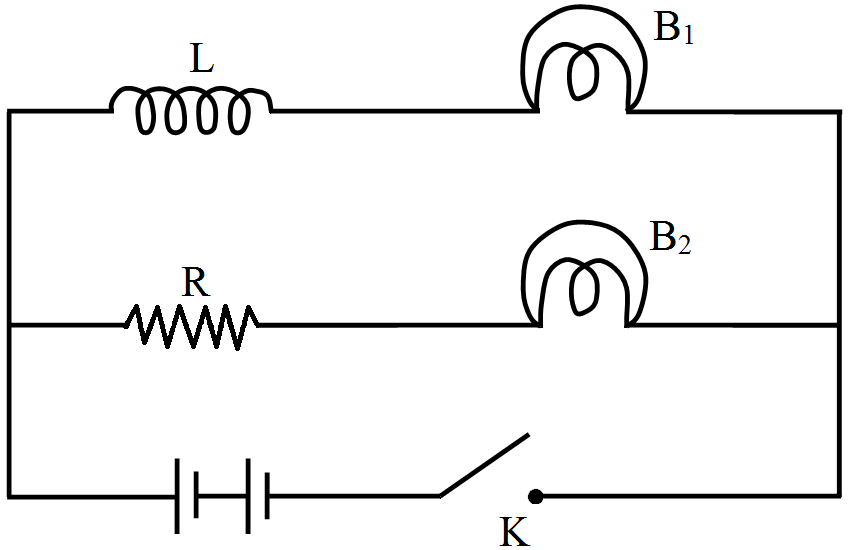
In the given circuit, the value of resistance effect of the coil $L$ is exactly equal to the resistance $R.$ Bulbs $B_1$ and $B_2$ are exactly identical. Answer the following questions based on above information:
  1. Which one of the two bulbs lights up earlier, when key $K$ is closed and why?
  2. What will be the comparative brightness of the two bulbs after sometime if the key $K$ is kept closed and why?
In Exercise $4.11$ obtain the frequency of revolution of the electron in its circular orbit. Does the answer depend on the speed of the electron? Explain.