Question
A molecule. of hydrogen contains two protons and two electrons. The nuclear force between these two protons is always neglected while discussing the behaviour of a hydrogen molecule. Why?

Answer

Inside the nucleus, two protons exert nuclear force on each other. These forces are short-ranged (a few fm), strong and attractive forces. They also exert electrostatic repulsive force (long-ranged). While discussing the behaviour of a hydrogen molecule, the nuclear force between the two protons is always neglected. This is because the separation between the two protons in the molecule is ~70pm which is much greater than the range of the nuclear force.

Need a full question paper?

Generate a complete, print-ready paper with questions like this in minutes — across 16+ boards, with answer keys.
Start Generating Free

Similar questions

A nearsighted person cannot see beyond 25cm. Assuming that the separation of them glass from the eye is 1cm, find the power of lens needed to see distant objects.
If one mole of ideal monoatomic gas $\Big(\gamma=\frac{7}{5}\Big)$ is mixed with one mole of diatomic gas $\Big(\gamma=\frac{7}{5}\Big).$ What is the value of y for the mixtures?
(Here, $\gamma$ represents the ratio of specific heat at constant pressure to that at constant volume)
A charge of 1.0C is placed at the top of your college building and another equal charge at the top of your house. Take the separation between the two charges to be 2.0km. Find the force exerted by the charges on each other. How many times of your weight is this force?
Two trains, each having a speed of $30 km / h$, are headed towards each other on the same track. A bird that can fly $60 km / h$ flies off the front of one train when they were 60 km apart and heads directly to the other train. On reaching the train, the bird flies back to the first train. What is the total distance the bird travels before the trains collide?
Suppose an attractive nuclear force acts between two protons which may be written as $\text{F}=\text{Ce}^{-\text{kr}}/\text{r}^2.$
  1. Write down the dimensional formulae and appropriate SI units of C and k.
  2. Suppose that k = 1 fermi-1 and that the repulsive electric force between the protons is just balanced by the attractive nuclear force when the separation is 5 fermi. Find the value of C.
Prove that the path of a projectile is a parabola.
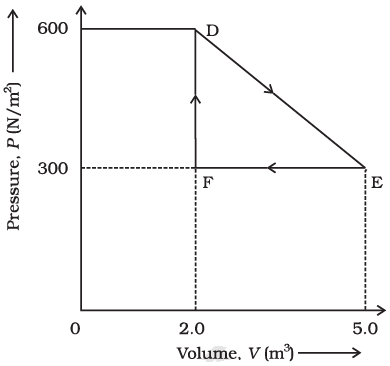
A thermodynamic system is taken from an original state to an intermediate state by the linear process shown in Fig.

Its volume is then reduced to the original value from E to F by an isobaric process. Calculate the total work done by the gas from D to E to F.

Find the difference in temperature across the surfaces of an iron plate 5 cm thick, through 100 sq. m of which heat flows at the rate of 9.6 ×10⁵ J/s.
[Take K = 96 Wm-1K-1]
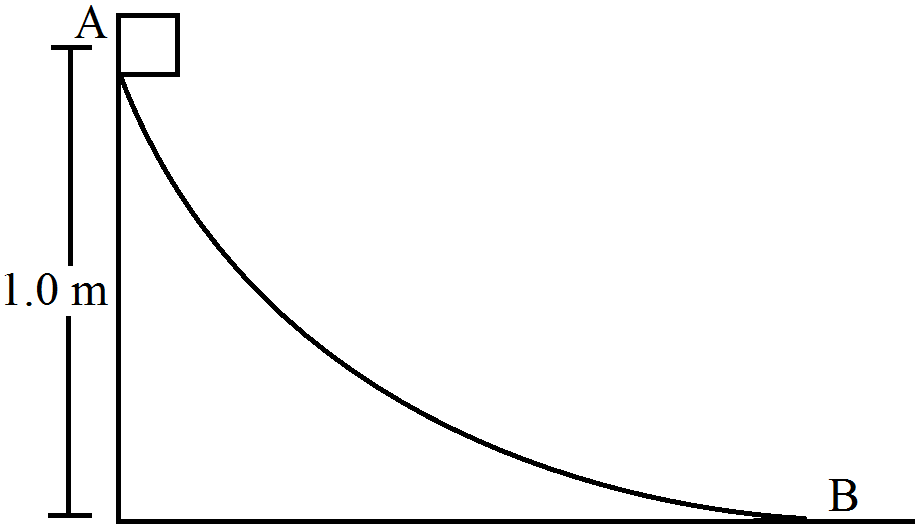
A block weighing 10N travels down a smooth curved track AB joined to a rough horizontal surface (figure). The rough surface has a friction coefficient of 0.20 with the block. If the block starts slipping on the track from a point 1.0m above the horizontal surface, how far will it move on the rough surface?

A Carnot engine absorbs 1000J of heat energy from a reservoir at 12.7°C and rejects 600J of heat energy during each cycle. Calculate. (i) efficiency of the engine, (ii) temperature of sink, (iii) amount of useful work done per cycle.