Question
 A more powerful vehiclewould complete a journey in a shorter timethan a less powerful one. We talk of the powerof machines like motorbikes and motorcars.The speed with which these vehicles changeenergy or do work is a basis for theirclassification. Power measures the speed ofwork done, that is, how fast or slow work isdone. Power is defined as the rate of doingwork or the rate of transfer of energy. If anagent does a work W in time t, then power isgiven by

P= work/time

P= W/T. The unit of power is watt.

(i) The rate of doing work is defined as

(a) Energy

(b) Force

(c) Power

(d) None of these

(ii) Total energy consumed divided by total time taken is called as

(a) Average power

(b) Instantaneous power

(c) Both a and b

(d) None of these

(iii) Let A and B having same weight start climbing the rope and reach height of 10m. Let A takes 10sec while B takes 12sec then work done

(a) By both will be same

(b) By A is more than work done by B

(c) By B is more than work done by A

(d) None of these

(iv) Define 1 Watt of power

(v) An electric bulb of 20W is used for 5h per day. Calculate the ‘units’ of energy consumed in one day by the bulb.

Answer

(i) c

(ii) a

(iii) a

(iv) A power is said to be 1 watt when 1 joule of work is done within 1 second of time.

(v) Power of electric bulb = 20 W

= 0.02 kW.

Time used, t = 5 h

Energy = power × time taken

= 0.02kW × 5 h

= 0.10 kW h

= 0.10‘units’.

The energy consumed by the bulb 0.10 units

Need a full question paper?

Generate a complete, print-ready paper with questions like this in minutes — across 16+ boards, with answer keys.

Start Generating Free

Similar questions

100ml of water at room temperature of 25°C is taken in a beaker and a little of solid S is dissolved in it by stirring to obtain a solution X. More and more of solid S is added to the solution with constant stirring, while keeping the temperature of solution constant at 30°C. After some time it is observed that no more solid dissolves in water and at the same time some solid is also left undissolved at the bottom of the beaker. The contents of beaker are filtered through a filter paper to obtain solution Y in the form of a filtrate.
  1. What name is given to solutions like X?
  2. What name is given to solution like Y?
  3. What will you observe if the solution Y at 30°C is cooled down to 10°C by keeping the beaker in crushed ice? Why?
  4. What term is used to denote the amount of solid dissolved in 100 grams of water in a solution like Y?
The covering or protective tissues in the animal body are epithelial tissues. Epithelium covers most organs and cavities within the body. External and Internal covering of the body and organs are all made of epithelial tissue.

Epithelial tissue cells are tightly packed and form a continuous sheet. They have only a small or almost no intercellular spaces.it plays an important role in regulating the exchange of materials between the body and the external environment and also between different parts of the body.

Simple squamous epithelial cells are extremely thin and flat and form a delicate lining. The oesophagus and the lining of the mouth are also covered with squamous epithelium. The skin, which protects the body, is also made of squamous epithelium.

Where absorption and secretion occur, as in the inner lining of the intestine, tall epithelial cells are present. This columnar (meaning ‘pillar-like’) epithelium facilitates movement across the epithelial barrier. In the respiratory tract, the columnar epithelial tissue also has cilia, which are hair-like projections on the outer surfaces of epithelial cells. These cilia can move, and their movement pushes the mucus forward to clear it. This type of epithelium is thus ciliated columnar epithelium.

Cuboidal epithelium (with cube-shaped cells) forms the lining of kidney tubules and ducts of salivary glands, where it provides mechanical support. Epithelial cells often acquire additional specialisation as gland cells, which can secrete substances at the epithelial surface. Sometimes a portion of the epithelial tissue folds inward, and a multicellular gland is formed. This is glandular epithelium.

(1) The ciliated columnar epithelium is present in

(a) Respiratory tract

(b) Bile duct and oesophagus

(c) Fallopian tube and urethra

(d) Eustachian tube and stomach lining

(2) The cuboidal epithelium is present in

(a) Bronchioles

(b) Bile duct and oesophagus

(c) Fallopian tube and urethra

(d) Kidney tubules ducts of salivary glands

(3) External and Internal covering of the body and organs are all made of ________

(a) Skin Tissue

(b) Epithelial Tissue

(c) Nerves Tissue

(d) Connective Tissue

(4) How are cells arranged in epithelial tissue?

(a) Loosely packed  

(b) Closely packed

(c) Arranged in discontinuous form   

(d) Both a and c

(5) Enlist the types of Epithelial Tissue?
The liquid air has three components X, Y and Z whose boiling points are: -186°C, -183°C and -196°C, respectively. When liquid air is fed into a tall fractional distillation column from near its bottom and warmed up slowly:
  1. Which component will be collected from near the bottom of the fraction distillation column? Why?
  2. Which component will be collected from the top part of the fractional distillation column? Why?
  3. Which component will be collected from the middle part of the fractional distillation column? Why?
  4. What could the component X, Y and Z be?
Rutherford (1871-1937) was known as the ‘Father’ of nuclear physics. He is famous for his work on radioactivity and the discovery of the nucleus of an atom with the gold foil experiment. Ernest Rutherford was interested in knowing how the electrons are arranged within an atom. Rutherford designed an experiment for this. In this experiment, fast moving alpha (α)-particles were made to fall on a thin gold foil. On the basis of his experiment, Rutherford put forward the nuclear model of an atom, which had the following features:

  • There is a positively charged centre in an atom called the nucleus. Nearly all the mass of an atom resides in the nucleus.
  • The electrons revolve around the nucleus in circular paths.
  • The size of the nucleus is very small as compared to the size of the atom.

Drawbacks of Rutherford’s model of the atom: The revolution of the electron in a circular orbit is not expected to be stable. Any particle in a circular orbit would undergo acceleration. During acceleration, charged particles would radiate energy. Thus, the revolving electron would lose energy and finally fall into the nucleus. If this were so, the atom should be highly unstable and hence matter would not exist in the form that we know. We know that atoms are quite stable.

(1) Which of the following scientist was known as the ‘Father of nuclear physics?

(a) J.J. Thomson

(b) John Dalton

(c) E. Rutherford

(d) Neilsbhore

(2) Positively charged centre in an atom is termed as

(a) Nucleus

(b) Molecule

(c) Atom

(d) Protons

(3) Identify the correct statement

Statement 1 – Positively charged centre in an atom called the nucleus.

Statement 2 – The electrons revolve around the nucleus in circular paths.

Statement 3 – Nearly all the mass of an atom resides in the nucleus.

Statement 4 – The size of the nucleus is very small as compared to the size of the atom.

(a) Only 2

(b) Both 3 & 4

(c) Both 1 & 2

(d) All of the above

(4) Write the features of Rutherford’s nuclear model of an atom?

(5) Define Nucleus.

Newton’s first law of motion states that a body at rest will remain at rest position only and a body which is in motion continues to be in motion unless otherwise they are acted upon by an external force. In other words, all objects resist a changein their state of motion. In a qualitative way, the tendency of undisturbed objects to stayat rest or to keep moving with the same velocity is called inertia. This is why, the firstlaw of motion is also known as the law of inertia. Answer the following questions.

(i) The first law of motion is also known as

(a)law of inertia/p>

(b)law of thermodynamics

(c)both a and b

(d)none of these

(ii) If no external force acts on object which is at rest. it will

(a)remain at rest

(b)start to move

(c)both a and b can possible

(d)none of these

(iii) If no external force acts on moving object. it will

(a)stop moving

(b)continue to move with same speed in same direction

(c)changes its direction of motion

(d)none of these

(iv) State Newton’s first law of motion.

(v) why Newton’s first law of motion is called law of inertia

A moving object can do work. An object moving faster can do more work than an identical object moving relatively slow. A moving bullet, blowing wind, a rotating wheel, a speeding stone can do work. How does a bullet pierce the target? How does the wind move the blades of a windmill? Objects in motion possess energy. We call this energy kinetic energy.Thus, the kinetic energy possessed by an object of mass, m and moving with a uniform velocity, $v$ is
$KE = ½ *mv^2$
The energy possessed by an object is thus measured in terms of its capacity of doing work. The unit of energy is, therefore, the same as that of work, that is, joule $(J).$
$(i)$ Energy possessed by body which is in motion is called
$(a)$ Potential energy
$(b)$ Kinetic energy
$(c)$ Nuclear energy
$(d)$ None of these
$(ii)$ Which of the following has same unit?
$(a)$ Potential energy and Force
$(b)$ Kinetic energy and work
$(c)$ Both $a$ and $b$
$(d)$ None of these
$(iii)$ Kinetic energy depends
$(a)$ Inversely on velocity of body
$(b)$ Directly on square of velocity of body
$(c)$ Directly on velocity of body
$(d)$ None of these
$(iv)$ Define kinetic energy of body. Give its $SI$ unit
$(v)$ Is kinetic energy scalar or vector? Justify your answer
We know that the earth attracts every object with a certain force and this force depends on the mass $(m)$ of the object and the acceleration due to the gravity $(g)$. The weight of an object is the force with which it is attracted towards the earth. Mathematically
$W = m \times g$
Where$, W =$ weight of object
$m =$ mass of object
$g =$ acceleration due to the gravitational force
As the weight of an object is the force with which it is attracted towards the earth, the $\text{SI}$ unit of weight is the same as that of force, that is, Newton $(N)$. The weight is a force acting vertically downwards; it has both magnitude and direction. We have learnt that the value of $g$ is constant at a given place. Therefore at a given place, the weight of an object is directly proportional to the mass, say $m,$ of the object, that is, $W \alpha \ m$. It is due to this reason that at a given place, we can use the weight of an object as a measure of its mass. Answer the following questions.
$(i)$ Unit of acceleration due to the gravity $(g)$ is
$(a) \ m/s$
$(b) \ m/s^2$
$(c)$ Newton $(N)$
$(d)$ None of these
$(ii)$ Direction of weight of any object is
$(a)$ Always towards centre of earth
$(b)$ Always away from centre of earth
$(c)$ Weight don’t have direction
$(d)$ None of these
$(iii)$ Which of the following has same unit
$(a)$ Mass and weight
$(b)$ Weight and force
$(c)$ Velocity and acceleration
$(d)$ None of these
$(iv)$ Whether weight is scalar quantity or vector quantity? Justify your answer.
$(v)$ Differentiate between mass and weight.
 A violin and a flute may both be played the same time in an orchestra. Bothsounds travel through the same medium,that is, air and arrive at our ear at the sametime. Both sounds travel at the same speedirrespective of the source. But the soundswe receive are different. This is due to thedifferent characteristics associated with thesound. Pitch is one of the characteristics.How the brain interprets the frequency ofan emitted sound is called its pitch. The fasterthe vibration of the source, the higher is the frequency and the higher is the pitch. The magnitude of the maximumdisturbance in the medium on either side ofthe mean value is called the amplitude of thewave. It is usually represented by the letter (A).

The loudness or softness of a sound isdetermined basically by its amplitude. Theamplitude of the sound wave depends uponthe force with which an object is made tovibrate. If we strike a table lightly, we hear asoft sound because we produce a sound waveof less energy (amplitude).

The quality or timber of sound is thatcharacteristic which enables us to distinguishone sound from another having the same pitchand loudness. The sound which is morepleasant is said to be of a rich quality. A sound of single frequency is called a tone. The sound which is produced due to a mixture of several frequencies is called a note and is pleasant to listen to. Noise is unpleasant to the ear! Music is pleasant to hear and is of rich quality.

(i) Pitch of sound is higher when

(a) Vibration of source of sound is higher

(b) Vibration of source of sound is Lower

(c) Independent of vibration of source of sound

(d) None of these

(ii) Loudness and softness of sound depends upon

(a) Frequency of sound

(b) Amplitude of sound

(c) Wavelength of sound

(d) None of these

(iii) Sound of single frequency is called

(a) Note

(b) Tone

(c) Noise

(d) None of these

(iv)If we strike a table lightly, we hear asoft sound. If we hit the tablehard we hear a louder sound up to large distance. Why?

(v) Determine which of the following has higher pitch railway horn or guitar?

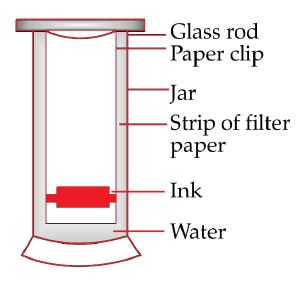
A child wanted to separate the mixture of dyes constituting a sample of ink. He marked a line by the ink on the filter paper and placed the filter paper in a glass containing water as shown in figure. The filter paper was removed when the water moved near the top of the filter paper.

(i) Identify the technique used by the child.

(a) Sedimentation(b) Filtration(c) Chromatography(d) Distillation

(ii) What would you expect to see, if the ink contains three different coloured components?
(a) We will not see any band on the filter paper.
(b) We would see three bands on the filter paper at various lengths.
(c) We would see infinite bands on the filter paper.
(d) We would see single band on the filter paper.


iii) Give one application where you can use this technique.
(a) To separate salt from sand
(b) To separate wheat from husk
(c) To separate oil from water
(d) To separate drugs from blood.


(iv) For the separation of what kind of substances is the above process used ?
(a) For the separation of insoluble substances
(b) For the separation of single solute that dissolves in single solvent.
(c) For the separation of those solutes that dissolve in the same solvent.
(d) For the separation of those solutes that dissolve in the different solvents.


(v) What is chromatography ?
(a) It is an agricultural method to separate grains
(b) A method to separate magnetic impurities from non-magnetic impurities
(c) The process of separating the suspended particles of an insoluble substance
(d) Method of separating and identifying various components in a mixture, which are present in small trace quantities.


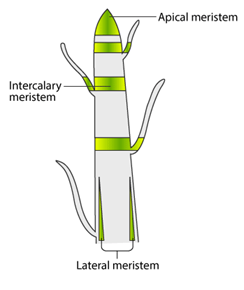
The growth of plants occurs only in certain specific regions. This is because the dividing tissue, also known as meristematic tissue, is located only at these points. Depending on the region where they are present, meristematic tissues are classified as apical, lateral and intercalary. New cells produced by meristem are initially like those of meristem itself, but as they grow and mature, their characteristics slowly change and they become differentiated as components of other tissues

Apical meristem is present at the growing tips of stems and roots and increases the length of the stem and the root. The girth of the stem or root increases due to lateral meristem (cambium). Intercalary meristem seen in some plants is located near the node

Cells of meristematic tissue are very active, they have dense cytoplasm, thin cellulose walls and prominent nuclei. They lack vacuoles.

(1) Which meristem helps in increasing the girth of the plant?

(a) Primary meristem

(b) Apical meristem

(c) Intercalary meristem

(d) Lateral meristem

(2) Lateral meristem is responsible for_____________

(a) Growth of apical portion

(b) Increase in the length

(c) Increasing the girth of stem and root

(d) Growth in parenchyma

(3) The meristem present at the base of the internode is_____________

(a) Lateral meristem

(b) Intercalary Meristem

(c) Apical Meristem

(d) All of the above

(4) What are the characteristic of Meristematic tissue?

(5) Enlist the type of meristematic tissue.