Question
 A more powerful vehiclewould complete a journey in a shorter timethan a less powerful one. We talk of the powerof machines like motorbikes and motorcars.The speed with which these vehicles changeenergy or do work is a basis for theirclassification. Power measures the speed ofwork done, that is, how fast or slow work isdone. Power is defined as the rate of doingwork or the rate of transfer of energy. If anagent does a work W in time t, then power isgiven by

P= work/time

P= W/T. The unit of power is watt.

(i) The rate of doing work is defined as

(a) Energy

(b) Force

(c) Power

(d) None of these

(ii) Total energy consumed divided by total time taken is called as

(a) Average power

(b) Instantaneous power

(c) Both a and b

(d) None of these

(iii) Let A and B having same weight start climbing the rope and reach height of 10m. Let A takes 10sec while B takes 12sec then work done

(a) By both will be same

(b) By A is more than work done by B

(c) By B is more than work done by A

(d) None of these

(iv) Define 1 Watt of power

(v) An electric bulb of 20W is used for 5h per day. Calculate the ‘units’ of energy consumed in one day by the bulb.
Answer

(i) c

(ii) a

(iii) a

(iv) A power is said to be 1 watt when 1 joule of work is done within 1 second of time.

(v) Power of electric bulb = 20 W

= 0.02 kW.

Time used, t = 5 h

Energy = power × time taken

= 0.02kW × 5 h

= 0.10 kW h

= 0.10‘units’.

The energy consumed by the bulb 0.10 units

Need a full question paper?

Generate a complete, print-ready paper with questions like this in minutes — across 16+ boards, with answer keys.

Start Generating Free

Similar questions

We know that the earth attracts every object with a certain force and this force depends on the mass (m) of the object and the acceleration due to the gravity (g). The weight of an object is the force with which it is attracted towards the earth. Mathematically

W = m x g

Where, W= weight of object

m= mass of object

g= acceleration due to the gravitational force

As the weight of an object is the force with which it is attracted towards the earth, the SI unit of weight is the same as that of force, that is, Newton (N). The weight is a force acting vertically downwards; it has both magnitude and direction. We have learnt that the value of g is constant at a given place. Therefore at a given place, the weight of an object is directly proportional to the mass, say m, of the object, that is, W αm. It is due to this reason that at a given place, we can use the weight of an object as a measure of its mass. Answer the following questions.

(i) Unit of acceleration due to the gravity (g) is

(a) m/s

(b) m/s2

(c) Newton(N)

(d) None of these

(ii) Direction of weight of any object is 

(a) Always towards centre of earth

(b) Always away from centre of earth

(c) Weight don’t have direction

(d) None of these

(iii) Which of the following has same unit

(a) Mass and weight

(b) Weight and force

(c) Velocity and acceleration

(d) None of these

(iv) Whether weight is scalar quantity or vector quantity? Justify your answer.

(v) Differentiate between mass and weight.

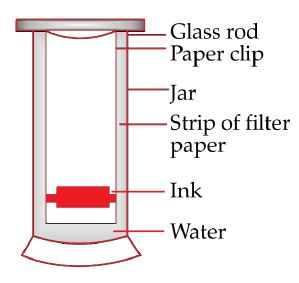
A child wanted to separate the mixture of dyes constituting a sample of ink. He marked a line by the ink on the filter paper and placed the filter paper in a glass containing water as shown in figure. The filter paper was removed when the water moved near the top of the filter paper.

(i) Identify the technique used by the child.

(a) Sedimentation(b) Filtration(c) Chromatography(d) Distillation

(ii) What would you expect to see, if the ink contains three different coloured components?
(a) We will not see any band on the filter paper.
(b) We would see three bands on the filter paper at various lengths.
(c) We would see infinite bands on the filter paper.
(d) We would see single band on the filter paper.


iii) Give one application where you can use this technique.
(a) To separate salt from sand
(b) To separate wheat from husk
(c) To separate oil from water
(d) To separate drugs from blood.


(iv) For the separation of what kind of substances is the above process used ?
(a) For the separation of insoluble substances
(b) For the separation of single solute that dissolves in single solvent.
(c) For the separation of those solutes that dissolve in the same solvent.
(d) For the separation of those solutes that dissolve in the different solvents.


(v) What is chromatography ?
(a) It is an agricultural method to separate grains
(b) A method to separate magnetic impurities from non-magnetic impurities
(c) The process of separating the suspended particles of an insoluble substance
(d) Method of separating and identifying various components in a mixture, which are present in small trace quantities.

Archimedes’ principle, stated as follows: When a body is immersed fully or partiallyin a fluid, it experiences an upward force thatis equal to the weight of the fluid displacedby it. The upward force is known as up thrust or buoyant force. In fact, all objects experience a force of buoyancy when they are immersed in a fluid. The magnitude of this buoyant force depends on the density of the fluid.Objects having density less than that of the liquid in which they are immersed float on the surface of the liquid. If the density of the object is more than the density of the liquid in which it is immersed then it sinks in the liquid. Hence body will float or sink depends upon difference between density of body and fluid.

(i)The up thrust of the body is equal to the

(a) Mass of liquid

(b) Weight of liquid

(c) Weight of liquid displaced by body

(d) None of these

(ii) If the density of the object is more than the density of the liquid in which it is immersed then

(a) It sinks in liquid

(b) It floats on liquid

(c) It comes out of liquid

(d) None of these

(iii) When anybody immersed in liquid it experience a force called as

(a) Gravitational force

(b) Buoyancy force

(c) Nuclear force

(d) None of these

(iv) State Archimedes’ principle.

(v) Why does cube of plastic released deep down under the water come up to surface of water?

The third law of motion states that when one object exerts a force on another object, the second object instantaneously exerts a force back on the first. These two forces are always equal in magnitude but opposite in direction. These forces act on different objects and neveron the same object. It is important to note that even though the action and reaction forces are always equal in magnitude; these forces may not produce accelerations of equal magnitudes, this is because each force acts on a different object that may have a different mass.The two opposing forces are also known as action and reaction forces. Answer the following questions.

(i) Action reaction forces are always

(a) Equal and in same direction

(b) Equal and in opposite direction

(c) Unequal and in same direction

(d) None of the above

(ii) Which of the following is correct about action reaction forces?

(a) They act on different objects

(b) They are equal in magnitude and opposite in direction

(c) Both forces acted on different object simultaneously

(d) All the above

(iii) State third law of motion

(iv) Give 5 examples of third law of motion

(v) Even though the action and reaction forces are always equal in magnitude; these forces may not produce accelerations of equal magnitudes. Give your justification on this statement

The form of energy can be changed from one form to another. What happens to the totalenergy of a system during or after the process?Whenever energy gets transformed, the totalenergy remains unchanged. This is the law ofconservation of energy. According to this law, energy can only be converted from one form to another it can neither be created nor destroyed. The total energy before and after the transformation remains the same.The lawof conservation of energy is valid inall situations and for all kinds of transformations. Thus during motion the sum of the potential energy and kinetic energy of the object would be the same at all points. That is, potential energy + kinetic energy = constant.Andcalled as mechanical energy.

(i) Which of the energy conversion occur in electric iron?

(a) Electric energy converted into heat energy

(b) Electric energy converted into light energy

(c) Heat energy converted into electrical energy>

(d) None of these

(ii) When ball drops from height which of the energy conversion takes place

(a) Gravitational potential energy converted into kinetic energy

(b) Kinetic energy converted into Gravitational potential  energy

(c) Heat energy converted into electrical energy

(d) None of these

(iii) When ball is thrown vertically upward which of the following quantity remains constant?

(a) Energy

(b) Force

(c) Potential energy

(d) None of these

(iv) State law of conservation of energy.

(v) In hydroelectric power plant which energy conversion happens?

When the solid A is added to water, it dissolves with the evolution of a lot of heat and making little explosions to form two products B and C. The properties of products B and C are entirely different from those of solid A as well as water. Moreover, products B and C cannot be reconverted into solid A and water. When another solid D is added to water, it dissolves with the absorption of a little heat to form a product E which cools down. The product E shows the properties of both, solid D as well as water. Moreover, product E can be converted into solid D and water.
  1. What type of change occurs when solid A is dissolved in water? Why?
  2. What type of change occurs when sold D is dissolved in water? Why?
  3. Name a metal which you think could behave like solid A. Also name the products B and C.
  4. Name the solid D if it is the one which is used in making ordinary dry cells.
  5. Name the process by which D can be recovered from E.
Sound is produced by vibrating objects. The matter or substance through which sound is transmitted is called a medium. It can be solid, liquid or gas. Sound moves through a medium from the point of generation to the listener. When an object vibrates, it sets the particles of the medium around it vibrating. The particles do not travel all the way from the vibrating object to the ear. Sound waves are characterized by the motion of particles in the medium and are called mechanical waves.When a vibrating objectmoves forward, it pushes and compresses theair in front of it creating a region of highpressure; this region is called a compression(C).When the vibrating object moves backwards,it creates a region of low pressure calledrarefaction (R). Hence sound is longitudinal wave.

(i) Sound waves are

(a) Mechanical waves

(b) Electromagnetic wave

(c) Transverse waves

(d) None of these

(ii) Sound travel in medium with

(a) Compression and rare fraction

(b) Crest and trough

(c) Both can be possible

(d) None of these

(iii) Compression is the region of

(a) High pressure

(b) Low pressure

(c) Medium pressure

(d) None of these

(iv) What is sound and how is it produced?

(v) Why sound wave is called as longitudinal wave?

 Do we always need to heat or change pressure for changing the state of matter? Can you quote some examples from everyday life where change of state from liquid to vapour takes place without the liquid reaching the boiling point? In the case of liquids, a small fraction of particles at the surface, having higher kinetic energy, is able to break away from the forces of attraction of other particles and gets converted into vapour. This phenomenon of change of a liquid into vapors at any temperature below its boiling point is called evaporation.

i.) Evaporation of liquid takes place at

a.) Boiling point

b.) Above boiling point

c.) Below boiling point

d.) None of these

ii.) Evaporation takes place at surface of liquid because

a.) They are heavy as compare to other particles

b.) They have sufficient kinetic energy to break the force

c.) They are light weight as compare to other particles

d.) None of these

iii.) During evaporation particles of liquid change into vapour

a.) From the surface

b.) From the bottom

c.) From all over the liquid

d.) None of these

iv.) Define evaporation.

v.) Explain process of evaporation

Rutherford (1871-1937) was known as the ‘Father’ of nuclear physics. He is famous for his work on radioactivity and the discovery of the nucleus of an atom with the gold foil experiment. Ernest Rutherford was interested in knowing how the electrons are arranged within an atom. Rutherford designed an experiment for this. In this experiment, fast moving alpha (α)-particles were made to fall on a thin gold foil. On the basis of his experiment, Rutherford put forward the nuclear model of an atom, which had the following features:

  • There is a positively charged centre in an atom called the nucleus. Nearly all the mass of an atom resides in the nucleus.
  • The electrons revolve around the nucleus in circular paths.
  • The size of the nucleus is very small as compared to the size of the atom.

Drawbacks of Rutherford’s model of the atom: The revolution of the electron in a circular orbit is not expected to be stable. Any particle in a circular orbit would undergo acceleration. During acceleration, charged particles would radiate energy. Thus, the revolving electron would lose energy and finally fall into the nucleus. If this were so, the atom should be highly unstable and hence matter would not exist in the form that we know. We know that atoms are quite stable.

(1) Which of the following scientist was known as the ‘Father of nuclear physics?

(a) J.J. Thomson

(b) John Dalton

(c) E. Rutherford

(d) Neilsbhore

(2) Positively charged centre in an atom is termed as

(a) Nucleus

(b) Molecule

(c) Atom

(d) Protons

(3) Identify the correct statement

Statement 1 – Positively charged centre in an atom called the nucleus.

Statement 2 – The electrons revolve around the nucleus in circular paths.

Statement 3 – Nearly all the mass of an atom resides in the nucleus.

Statement 4 – The size of the nucleus is very small as compared to the size of the atom.

(a) Only 2

(b) Both 3 & 4

(c) Both 1 & 2

(d) All of the above

(4) Write the features of Rutherford’s nuclear model of an atom?

(5) Define Nucleus.

Three mixtures A, B and C are obtained by stirring three different solids in water taken in separate beakers. When mixture A is allowed to stand for some time, then its particles settle at the bottom of the beaker. When a beam of light is passed through mixture A in a dark room, the path of light becomes visible when observed from the side of the beaker. When mixture B is allowed to stand for a considerable time, even then its particles do not settle down. Mixture B, however, scatters the beam of light just like mixture A. The particles of mixture C do not settle down on keeping and it also does not scatter a beam of light passing through it.
  1. What are the mixtures like A known as?
  2. What are the mixtures like B known as?
  3. What are the mixtures like C known as?
  4. Name the phenomenon exhibited by A and B which occurs on passing a beam of light through them.
  5. Name one mixture each which is like (i) A (ii) B, and (iii) C.