Question
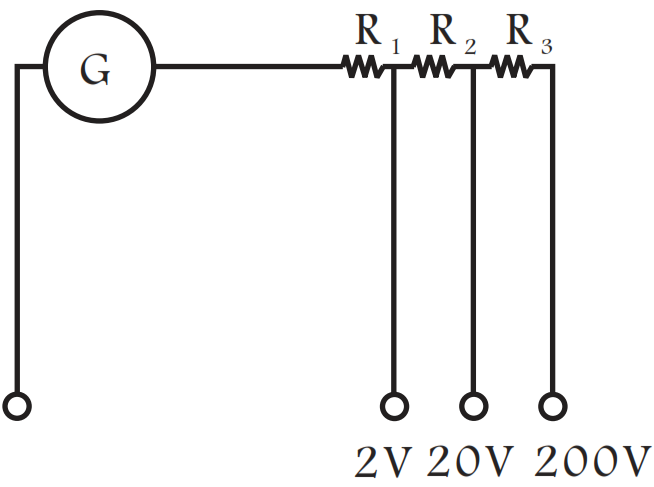
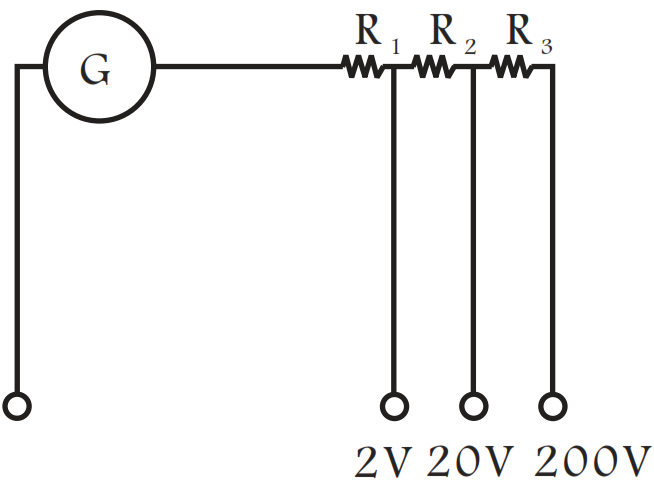
A multirange voltmeter can be constructed by using a galvanometer circuit as shown in Fig. We want to construct a voltmeter that can measure $2V, 20V$ and $200V$ using a galvanometer of resistance $10\Omega$ and that produces maximum deflection for current of $1mA$. Find $R_1, R_2$ and $R_3$ that have to be used.
Answer

Key concept: The galvanometer can also be used as a voltmeter to measure the voltage across a given section of the circuit. For this a very high resistance wire is to be connected in series with galvanometer. The relationship is given by $I_g(G + R)$ where $I_g$ is the range of galvanometer$, G$ is the resistance of galvanometer and $R$ is the resistance of wire connected in series with galvanometer.
Applying expression in different situations
For $I_g(G + R_1) = 2$ for $2V$ range
For $I_g(G + R_1 + R_2) = 20$ for $20V$ range
And For $I_g(G + R_1 + R_2 + R_3) = 200$ for $200V$ range
By solving, we get
$R_1 = 1990\Omega , R_2 = 18k\Omega$ and $R_3 = 180k\Omega .$

Need a full question paper?

Generate a complete, print-ready paper with questions like this in minutes — across 16+ boards, with answer keys.

Start Generating Free

Similar questions

A beam of monochromatic light of wavelength $\lambda$ ejects photoelectrons from a cesium surface $\big(\Phi=1.9\text{eV}\big).$ These photoelectrons are made to collide with hydrogen atoms in ground state. Find the maximum value of $\lambda$ for which (a) hydrogen atoms may be ionized, (b) hydrogen atoms may get excited from the ground state to the first excited state and (c) the excited hydrogen atoms may emit visible light.
Deutrium was discovered in $1932$ by Harold Urey by measuring the small change in wavelength for a particular transition in $1H$ and $2H$. This is because, the wavelength of transition depend to a certain extent on the nuclear mass. If nuclear motion is taken into account then the electrons and nucleus revolve around their common centre of mass. Such a system is equivalent to a single particle with a reduced mass $\mu ,$ revolving around the nucleus at a distance equal to the electron $-$ nucleus separation. Here $\mu=\frac{\text{m}_\text{e}\text{M}}{\text{m}_\text{e}+\text{M}}$ where $M$ is the nuclear mass and me is the electronic mass. Estimate the percentage difference in wavelength for the $1^{st}$ line of the Lyman series in $1H$ and $2H. ($Mass of $1H$ nucleus is $1.6725 \times 10^{-27}kg,$ Mass of $2H$ nucleus is $3.3374 \times 10^{-27}kg$, Mass of electron $= 9.109 \times 10^{-31}kg).$
A wave is described by the equation$\text{y}=(1.0\text{mm})\sin\pi\Big(\frac{\text{x}}{2.0\text{cm}}-\frac{\text{t}}{0.01\text{s}}\Big).$
  1. Find the time period and the wavelength.
  2. Write the equation for the velocity of the particles. Find the speed of the particle at x = 1.0cm at time t = 0.01s.
  3. What are the speeds of the particles at x = 3.0cm, 5.0cm and 7.0cm at t 0.01s?
  4. What are the speeds of the particles at x 1.0cm at t = 0.011, 0.012, and 0.013s?
With the help of circuit diagram, explain the working of junction diode as a full wave rectifier. Draw its input and output waveforms. Which characteristic property of junction diode makes it suitable for rectification?
A pendulum clock gives correct time at $20^\circ C$ at a place where $g = 9.800\ m s^{-2}$. The pendulum consists of a light steel rod connected to a heavy ball. It is taken to a different place where $g = 9.788\ m s^{-2}$. At what temperature will it give correct time ? Coefficient of linear expansion of steel $= 12 \times 10^{-6^\circ} C^{-1}$.
A particle of mass $100g $ moving at an initial speed $u$ collides with another particle of same mass kept initially at rest. If the total kinetic energy becomes $0.2J$ after the collision, what could be the minimum and the maximum value of $u$.
In Young’s double $-$ slit experiment using monochromatic light of wavelength $\lambda ,$ the intensity of light at a point on the screen where path difference is $\lambda ,$ is $K$ units. What is the intensity of light at a point where path difference is $\lambda /3$?
A capacitor is made of two circular plates of radius $R$ each, separated by a distance $d < < R$. The capacitor is connected to a constant voltage. $A$ thin conducting disc of radius $r < < R$. and thickness $t < < r$ is placed at a centre of the bottom plate. Find the minimum voltage required to lift the disc if the mass of the disc is $m$.
A small transparent slab containing material of $\mu=1.5$ is placed along $AS _2 $$Figure$)$. What will be the distance from $O$ of the principal maxima and of the first minima on either side of the principal maxima obtained in the absence of the glass slab?
Image

$AC = CO = D , S _1 C = S _2 C = d < D$
A parallel$-$plate capacitor of plate area $40\ cm^2$ and separation between the plates $0.10\ mm,$ is connected to a battery of emf $2.0V$ through a $16\Omega$ resistor. Find the electric field in the capacitor $10\ ns$ after the connections are made.